
Tarot Symbolism: The Star Crown & Astrology
"A great and wondrous sign appeared in heaven: a woman clothed with the sun, with the moon under her feet and a crown of twelve stars on her head."
—Revelations 12:1
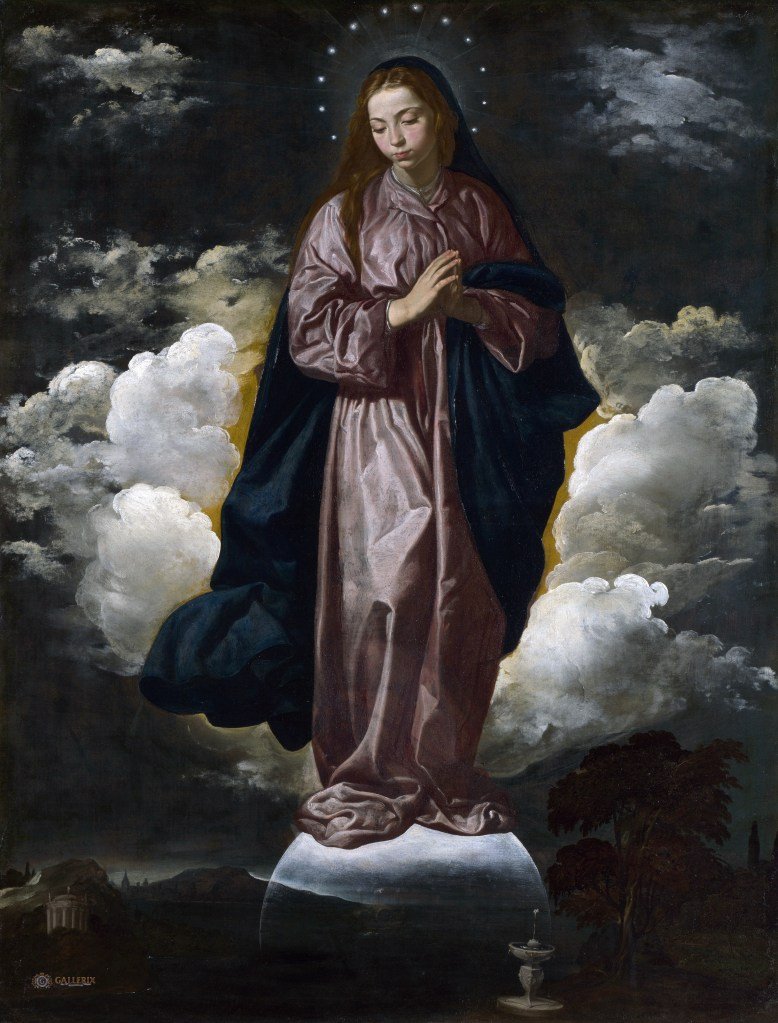
The Immaculate Conception, 1618-19, by Diego Velásquez via The Public Domain
What a beautiful image to picture. Especially if you, like me, swoon at the sight of anything celestial. If I saw a woman as described above—be it in a vision, a meditation, or a piece of artwork—I would think I'd stepped into heaven myself. This is probably why I love Medieval and Renaissance art so much. There are so many Marys floating in the sky with gold and stars. I especially love renderings of Her wearing an indigo robe embroidered with gold stars. It’s an aesthetic that I can’t get enough of.
But I digress already, and we’ve only just started.
Why a Crown of Stars?
The line from Revelations just may explain why Pamela Colman Smith painted her Empress wearing a crown of twelve stars. In fact, I’ll save you a lot of time and state clearly: I wholeheartedly believe this is a direct apropos. Not necessarily to explicitly state that the Empress is another Marian figure, but to say she possesses the qualities of Mary as blessed mother.
Which Waite mentions when he writes:
She is not Regina coeli, but she is still refugium peccatorum, the fruitful mother of thousands…a woman clothed with the sun, as Gloria Mundi and the veil of the Sanctum Sanctorum; but she is not, I may add, the soul that has attained wings...the card of the Empress signifies the door or gate by which an entrance is obtained into life…”
Not only is there a direct reference in his description to the Biblical quote above, but he, in so many words, confirms that she is to be represented as that divine figure who gives birth to sacred life on earth. For instance, he says she is not Regina coeli, which translates to “Queen of Heaven,” but is refugium peccatorum, i.e., “Blessed Mother.” In Catholic theology, Mary of Nazareth is given three levels of status—Blessed Virgin (human), Blessed Mother (human), and after Her death She is elevated to Queen of Heaven (divine) and seated at the right hand of Her son, where She becomes the feminine side of His divinity.
(If you want to learn more about how Christianity in practice wasn't a monotheistic religion but actually had quite a few goddesses, Mary being one of them, I highly recommend this book by Barbara Newman .)
Through the history of medieval & Renaissance art, when many of these distinctions were being laid down and broadcast as Catholic doctrine, lay people knew which iteration of Mary they were venerating based on… that’s right, you guessed it… the symbols she’s shown with. Or as we refer to them in art history, her attributes.
As the Blessed Virgin, she is often seen with the Angel Gabriel, a lily in a vase, or a lily of the valley, usually in a domestic scene with a book and an open window.
As the Blessed Mother, she will be shown with a halo, and sometimes a crown of stars—often, but not always, twelve—and holding Her infant/toddler Jesus.
As Queen of Heaven, she is in the sky, with a halo, and sometimes the crown of stars. Her Son and His Father sometimes appear and are shown lowering the crown (starred or otherwise) onto her head. Sometimes it's a band of angels.
The attributes listed above aren't necessarily set in stone anywhere, and given the sheer number of Mary paintings worldwide, symbolism overlaps and/or changes over time and from region to region.
For instance, in the painting above, she is the woman from the Revelations verse. She stands on the moon and has the halo of twelve stars around her head. For dramatic effect, Velázquez didn't surround her overtly with gold. The dark palette adds to the painting's drama and reflects the style of his time. (Plus, it's gorgeous this way!) Instead, he hints at the sunlight with the subtle glow of gold around her robes. He titled it The Immaculate Conception, straying from the common iconography of the domestic setting and angel Gabriel, and instead referenced Her prophetic conception.
It can be a little confusing because depictions of Her as the Queen of Heaven in art often match the line from Revelations more than she as the Blessed Mother. She, as Blessed Mother, can blend with the depictions of Isis more, who is related to the High Priestess in their connection as being the goddesses who know what’s beyond the veil.
The Botticelli Connection Revisited
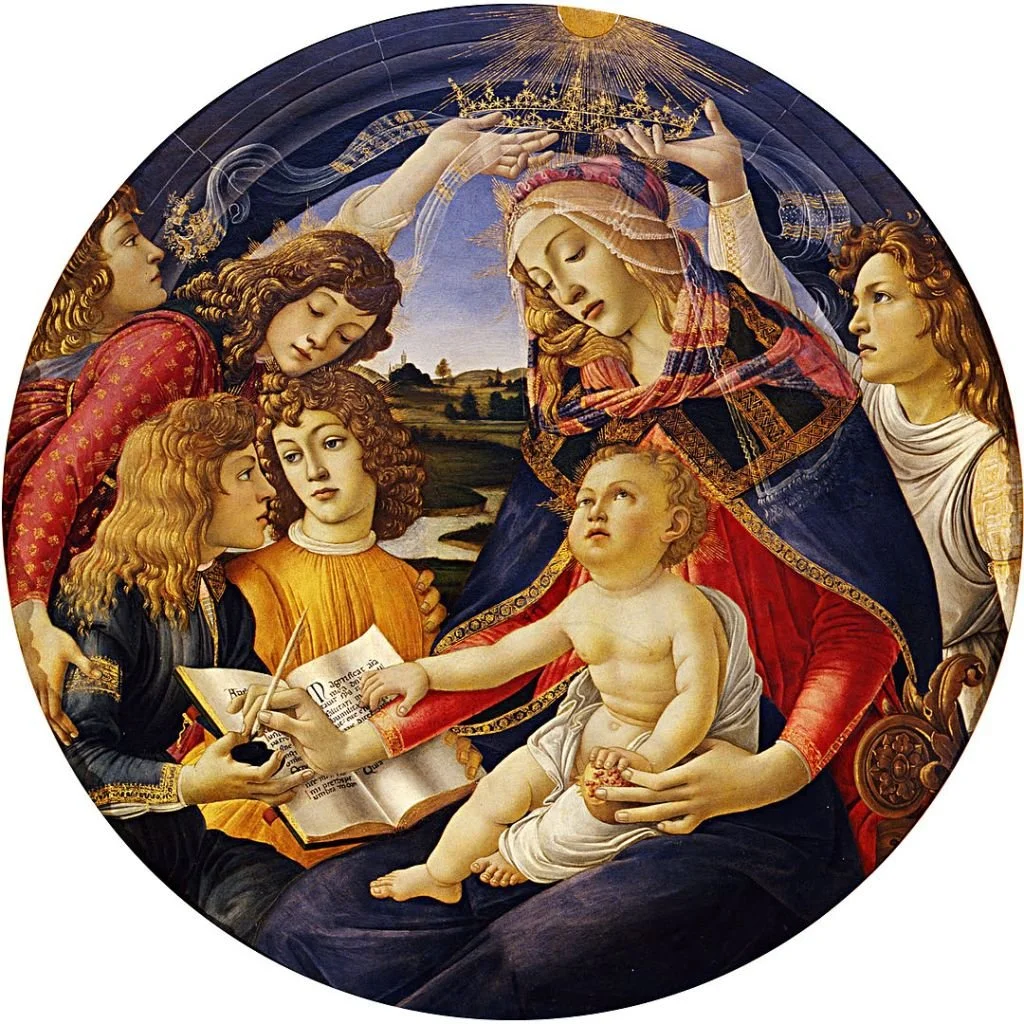
Sandro Botticelli, Madonna of the Magnificat, 1481, Uffizi Galleria
No, while the visual symbolism may be a little confusing, I posit that it's more likely Smith chose the crown of twelve stars to represent the Empress as that gateway-to-life-on-earth aspect because the line from Revelations describes the prophetic vision that Mary would one day come to give birth to the Savior, Jesus Christ. And she would give a new life to all with that gift of His life. And at the very least, with Smith’s and Waite’s goal to “rectify” the tarot deck by introducing more of the symbolism surrounding the Christian mysteries, when your average tarot reader in early 20th-century Europe saw the twelve-starred crown, they would’ve recognized the reference.
My conclusion also draws on the Botticelli connection. In a previous post about the Empress as personified Spring, I mentioned the extreme likeness of the Empress herself to two figures painted by Botticelli that are (and were at the time Pamela C. Smith was alive) hanging in the same wing of the Uffizi in Florence, Italy. It just so happens that on display in that same wing is another painting by Master Botticelli, Madonna of the Magnificat. And what does it show? Mary, the Blessed Mother—signified by the infant Jesus sitting on her lap—is being crowned with a diadem of graceful, delicate stars. While not exactly twelve, and not showing the six-pointed variety of Smith’s creation, we must remember her painting style was more akin to the flat, bold use of color found in the Japanese block-print style she so admired and emulated.
You may be asking, if this is the meaning behind her crown and its twelve stars, then why do so many tarot readers and writers believe it’s related to the twelve signs of the Zodiac?
A Little Bit About the Smith & Waite Influence
Primarily, I believe it’s because it isn't common knowledge that Waite and Smith were intentionally drawing on Christian Iconography and those mysteries for their deck. Most know them as members of the Hermetic Order of the Golden Dawn, which leaned more toward esoteric occultism and Kabbalah.

Photo of Pamela Colman Smith in the October 1912 issue of The Craftsman magazine
And most seem to completely disregard Pamela Smith’s contribution to the deck. Arthur Waite certainly did, given how often he glosses over significant symbols she used in his descriptions of "his" cards. The more I take this deep dive into their deck, the more contradictions I find between what he tells us and what she shows us. And how often does her name get dropped from how we refer to the deck? I hear it all the time. People call it the "Rider-Waite" deck. And by fellow deck creators! Fellow artists! Fellow women! Who don't seem to mind that they're discrediting the artist from which their own decks are so often derived.
For the record, Rider was the name of the original publisher. They had nothing to do with the creation of the deck. They are no longer the deck's publisher. If anyone’s name should be dropped, it’s theirs.
But again I digress, and I will step down off my soapbox for now to continue with the topic at hand.
Even taking into account that people are largely unaware that Waite and Smith were greatly influenced by their role as Golden Dawn members and by their mutual interest in Christian mysteries and symbolism (for the deck that is, perhaps, more influenced by the GD—see Aleister Crowley's Thoth tarot deck); even considering that most people put more stock into what A.E. Waite contributed to the deck, at no point does he mention anything having to do with astrology in The Pictorial Key to the Tarot description for the Empress.
And Finally, A Brief Introduction to Tarot + Astrology Connections
Ultimately, I believe the astrological reference comes from nearly a century of people interpreting the symbols based on their personal point of reference, then writing it down and sharing it as if it were canon. Which I take as only a small issue. I mean, I wish more people would consider the history and the alternative meanings before they publish a book and state something as if it were the only meaning. But I encourage people to branch out, share their personal interpretations, and add to the dialogue!
The Venus symbol also appears on the card, which is used to identify both the goddess and the planet; therefore, people may have seen it as a sign that this card is ruled by the planet Venus and, therefore, she is an astrological goddess.
It may be that the Wheel card (see below) leads people to believe that astrological symbolism plays a more prevalent role in the deck than it does. However, although the wheel in the card is laid out like an astrological wheel, the symbols in the center are alchemical, and the letters on the outside are Hebrew. The four figures around the corners are often misinterpreted as being tied to Zodiac signs, but they are the symbols used for the Four Evangelists—the authors of the four gospels of the New Testament. The wings and books connect these back to Christian Iconography prominent in Western art dating back to the medieval period. And Anubis, the snake, and the Sphinx are there to remind us of the cyclical nature of life.
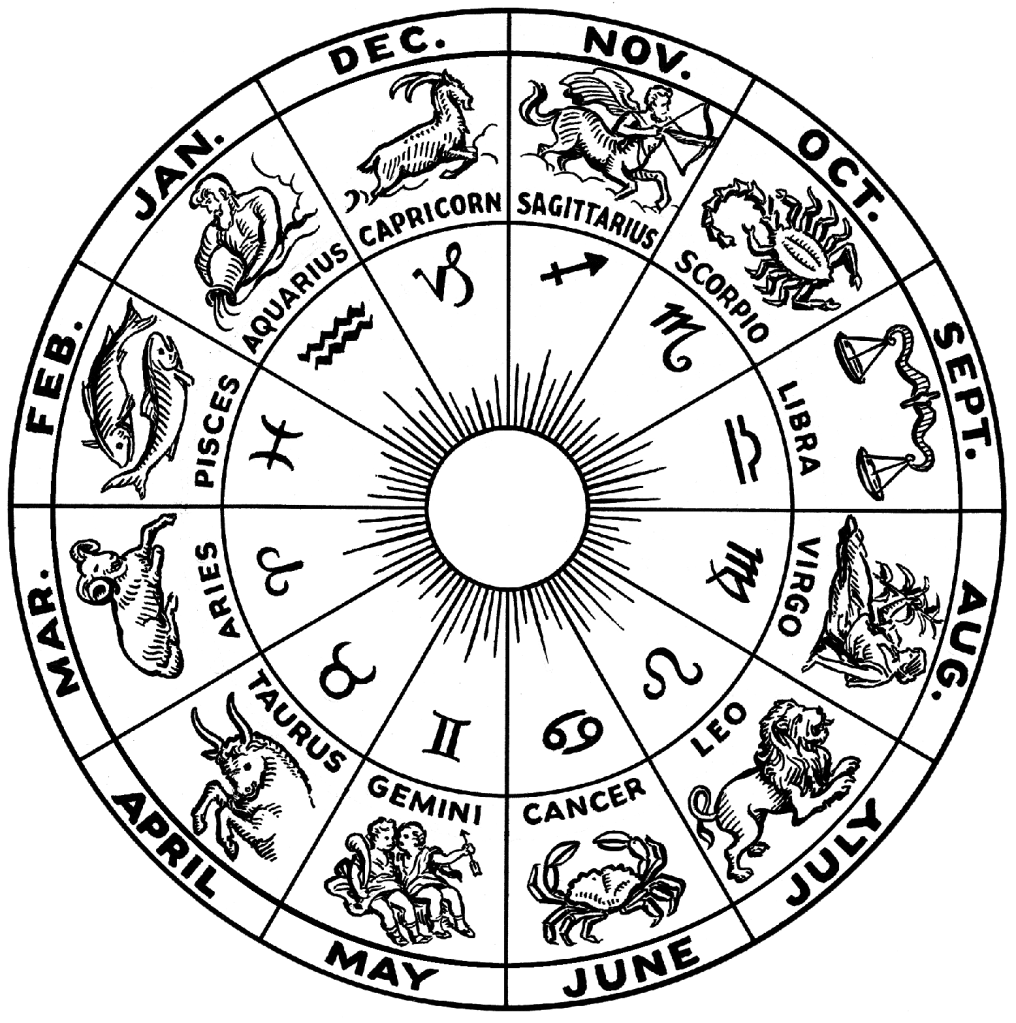
Modern zodiac wheel showing the 12 signs used in horoscopic astrology
Regardless of why the astrological interpretation of her crown has been accepted, the fact that this meaning has evolved over time is like Webster adding new words to the dictionary. It shows the development of a symbolic language based on tarot practice. In other words, just as everyday vernacular changes the dictionary[1], tarot readings and interpretations have changed the symbolic language. However, I will note that in the dictionary, the original definition and the origin of the word are listed right there along with the addition. They don't replace the meaning. Even when a meaning isn't widely used anymore, it's still listed under archaic.
This is the magic of the tarot, though! That if you believe those twelve stars are a symbol of the interconnectedness of the universe through the astronomical and astrological wheel of the year, then guess what?! It doesn’t change the archetypal meaning of the Empress one bit!
Because if her archetype is that mother goddess figure, i.e., the goddess of all creation, then she would be the ruler of the astrological wheel as well. And thus, we can begin to look at some of the correspondences between tarot and astrology. As with everything else about this practice, there are layers upon layers of connections between these two divination practices and their symbolism. Today, I provide a brief list of the Major Arcana cards and their zodiac and celestial body correspondences.
So please let me be clear: I don't disagree with this interpretation, nor do I discourage anyone from it. I merely have an overly pedantic nature that tends to get fastidious over details I find important (like Pamela Smith getting the credit she deserves!). I hope you won't hold this against me, as I share all of this out of pure passion and a desire for the world to remain connected to the practice's roots and recognize its evolution.
I have been learning more about astrology as well, and I find that regardless of whether Smith and Waite intended it, the two studies overlap and complement each other greatly.
And so without further ado, I will give a brief list of the correspondences below with every intention to go into further depth about the basis for these in another post, as that information needs far more space than I have to give here.
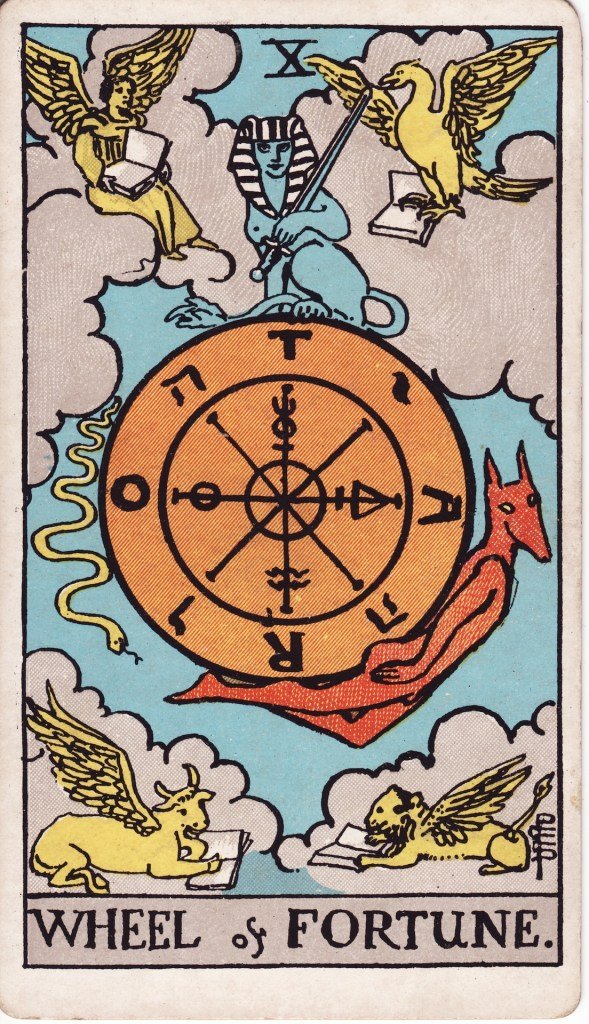
The Wheel Major Arcana card, Pamela Colman Smith, 1909
My Correspondences By Sign:
Aries - The Fool
Taurus - The Magician
Gemini - The Lovers & The Devil
Cancer - The Moon
Leo - Strength
Virgo - The Emperor
Libra - Justice
Scorpio - Death
Sagittarius - Temperance
Capricorn - The Chariot
Aquarius - The Star
Pisces - The High Priestess
By Celestial Body:
Sun - Sun
Moon - Moon
Mercury - Magician
Venus - Empress
Mars - Chariot
Jupiter - Justice
Saturn - Hierophant
Uranus - The Hanged Man
Neptune - The Hermit
Pluto - Tower
Note: these are my associations. They differ slightly from the established list by the Golden Dawn and what you will read in other books, blogs, and lists. Mine are based on my understanding of the energy of the cards + the energy of the signs and celestial bodies and how they are similar.
For the list according to the Golden Dawn:
The Planets
Mercury– Magician
Moon – High Priestess
Venus – Empress
Jupiter – Wheel of Fortune
Mars– Tower
Sun– Sun
Saturn– World
The Star Signs
Aries – Emperor
Taurus– Hierophant
Gemini – Lovers
Cancer – Chariot
Leo – Strength
Virgo– Hermit
Libra– Justice
Scorpio– Death
Sagittarius– Temperance
Capricorn – Devil
Aquarius– Star
Pisces– Moon
If you've made it this far with me, I love you with the passion of a thousand suns for that.
Next up, we're going to look at the masculine in the tarot with a focus on the Emperor & the Hierophant. So until next time...
♥️ BB Soto
Notes
For instance, the definition of tea was updated recently to include infusions made with leaves of herbal plants, despite it originally being specific only to the drink steeped with the leaves of the tea plant—Camellia sinensis—because of common language use in people calling their drinks "herbal tea."
Bibliography
Arroyo, Stephen. Astrology, Psychology, and the Four Elements: An Energy Approach to Astrology & Its Use in the Counseling Arts. 1st ed. Davis, Calif.: CRCS Publications, 2013. - https://bookshop.org/a/101141/9780916360016
“Bible Gateway Revelation 12 :: NIV.” 2024. Mit.edu. 2024. https://web.mit.edu/jywang/www/cef/Bible/NIV/NIV_Bible/REV+12.html.
Chang, T. Susan, and M. (Melissa) M. Meleen. Tarot Deciphered: Decoding Esoteric Symbolism in Modern Tarot. First edition. Woodbury, Minnesota: Llewellyn Publications, 2021. - https://bookshop.org/a/101141/9780738764474
Gillett, Roy. The Secret Laungauge of Astrology: The Illustrated Key to Unlocking the Secrets of the Stars. London, UK: Watkins Media Limited, 2012. - https://bookshop.org/a/101141/9781780283913
Ferguson, George. Signs & Symbols in Christian Art. London: Oxford University Press, 1989. - https://bookshop.org/a/101141/9780195014327
Kaplan, Stuart R., Mary K. Greer, Elizabeth Foley O’Connor, Melinda Boyd Parsons, and Pamela Colman Smith. Pamela Colman Smith: The Untold Story. First edition. Stamford, CT, USA: U.S. Games Systems, Inc., 2018. - https://bookshop.org/a/101141/9781572819122
Matthews, Caitlin. Sophia, Goddess of Wisdom, Bride of God. 1st Quest ed. Wheaton, Ill.: Quest Books, Theosophical Pub. House, 2001. - https://bookshop.org/a/101141/9780835608015
Robinson, Dawn. Pamela Colman Smith, Tarot Artist: The Pious Pixie. Stroud, United Kingdom: Fonthill Media, 2020. - https://bookshop.org/a/101141/9781781557419
“Twelve Stars in Revelation, Meaning : University of Dayton, Ohio.” 2024. Udayton.edu. March 2024. https://udayton.edu/imri/mary/t/twelve-stars-in-revelation-meaning.php.
Waite, Arthur. The Pictorial Key to the Tarot. US Games Inc., 2009. - https://bookshop.org/a/101141/9780486442556
Wen, Benebell. Holistic Tarot: An Integrative Approach to Using Tarot for Personal Growth. Berkeley, California: North Atlantic Books, 2015. - https://bookshop.org/a/101141/9781583948354
Image Credits
Circle of stars. (2024, January 21). In Wikipedia. https://en.wikipedia.org/wiki/Circle_of_stars
Madonna of the Magnificat. (2023, May 10). In Wikipedia. https://en.wikipedia.org/wiki/Madonna_of_the_Magnificat
Wheel of Fortune (tarot card). (2024, April 12). In Wikipedia. https://en.wikipedia.org/wiki/Wheel_of_Fortune_(tarot_card)
Zodiac. (2024, April 23). In Wikipedia. https://en.wikipedia.org/wiki/Zodiac

