
Tarot Symbolism: Stars
There is stardust in your veins. We are literally, ultimately children of the stars.
—Jocelyn Bell Burnell
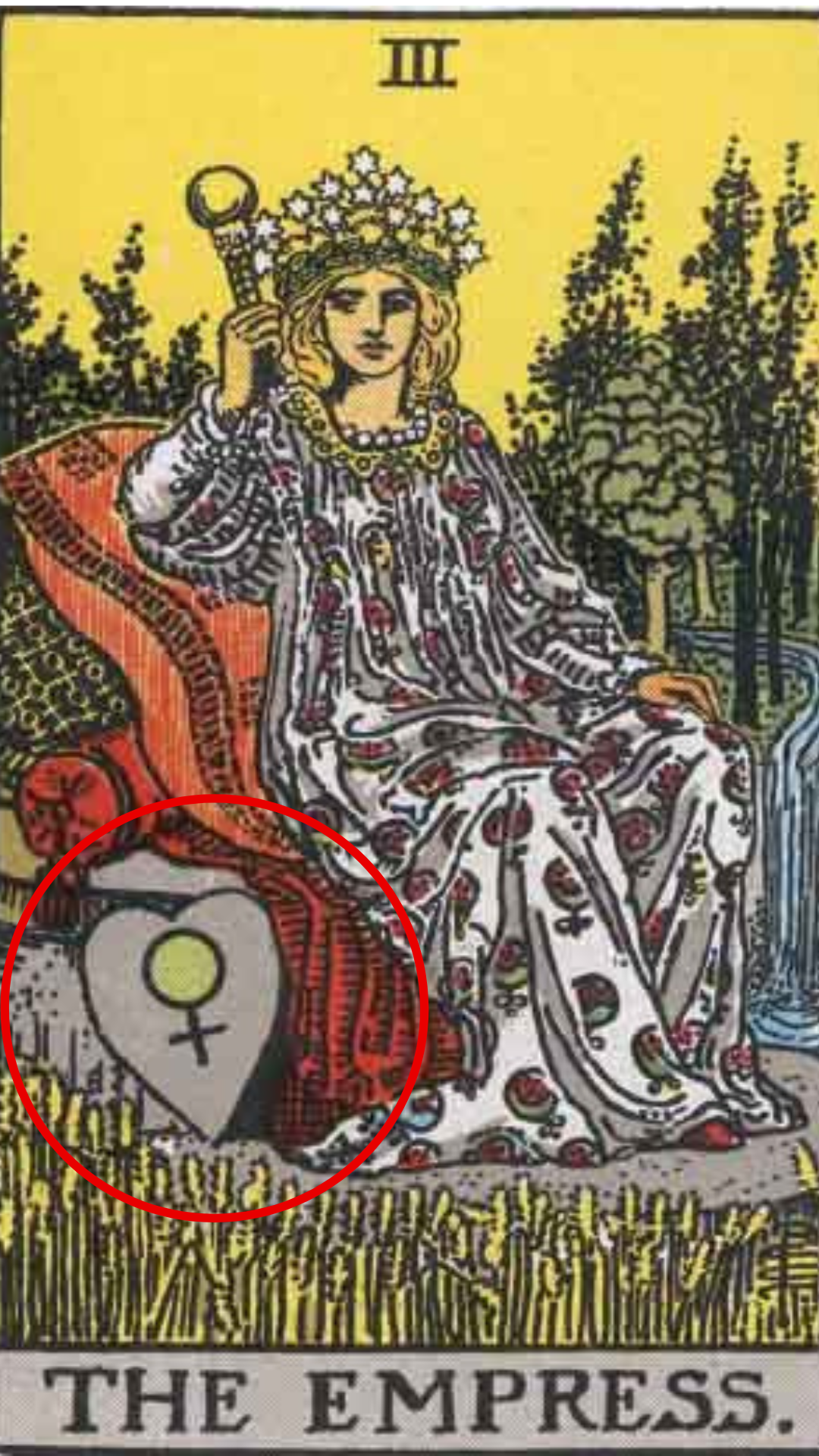
The Empress card, by Pamela Colman Smith, 1909
For as long as humans have looked up at night to watch the twinkling lights glitter against the black backdrop of space, humans have wondered at them and ascribed them mystical significance. Many cultures across the globe, going back as far as the historical record allows, believed stars encapsulated our risen souls after death, or an unborn soul, and in some cases were thought to house angels or deities. Across the board, though, there has been an otherworldly idea of their existence.
Of course, they are of another world. We, mere mortals, are relegated here to Earth, while they burn with the mysteries of the universe. Even with our scientific understanding of what they are, we will only ever be able to guess at why they are. And science can only describe and deduce their physical makeup. Just as biology only touches on the surface of what makes us human and has yet to be able to assign a physical definition to the soul, astronomers are only describing the basic parts of what makes a star a star. For all we still know, the energetic fire of our souls may just very well be rising to power one of nature’s most enigmatic and alluring tapestries.
For as far back as we have a record, humans have observed, charted, cataloged, and recorded the movements of the stars. It’s how we have calendars. It’s how some were able to be nomadic and move from place to place. Then it helped them explore even further. Not one human being alive today isn’t descended from, or part of, a culture whose ancestors studied the stars.
They have a powerful draw, the light in the dark. Perhaps one of the ultimate symbols of duality is that stars cannot be seen without the black of the night sky.
As guides, they symbolize that concept. A single star is often used to illustrate the idea of staying on course: faith, hope, a guiding light. This may be why the charioteer in The Chariot card has a single star on his crown—he is an archetypal symbol of being on course, directed, and focused.
In the stories surrounding the birth of Jesus, Buddha, and Agni—the Hindu fire god—an unusual star appeared to herald the auspicious event.
As constellations, they can be used to illustrate a meaning or a message relating to the zodiac, or the mythological characters and stories they are named for. From there, the intended meaning of why the constellation appears as a symbolic representation can be inferred from the context and knowledge of the constellation's mythological or historic significance.
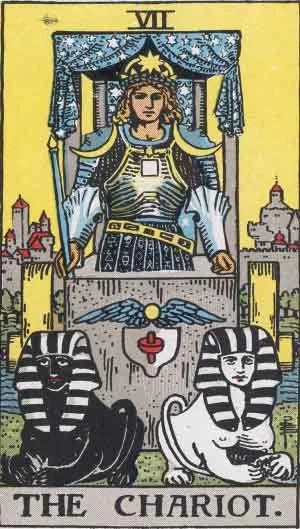
The Chariot card, by Pamela Colman Smith, 1909
The symbolic language of using stars to convey meaning gets more nuanced based on the number of points the star has.
Four-pointed stars may be used to represent the North Star in that the four points relate to the four cardinal directions. In Catholicism, a four-pointed star is sometimes used to represent the Star of Bethlehem, the star used by the three kings and shepherds to find the manger where Mary gave birth to Jesus—the same concept as the North Star as a guiding star.
The Pentagram is a polygon star with five points, and the star shape most often referred to by its mathematical term. The Pentagram inside a circle is the symbol for the Pentacles—or Coins—suit in most tarot decks. According to The Element Encyclopedia of Secret Signs and Symbols:
“The ubiquity of this sign can’t be stressed enough. It is associated not only with pagan practice but also with Christian mysticism. Druidry, magic, sacred geometry, alchemy, and the Kabbalah; it appears in the Tarot where it can represent the suit of Coins, and it is an important symbol in Freemasonry, where it is called the ‘Blazing Star.’”
The Pentagram makes a second appearance with the Devil card in Pamela Colman Smith’s deck, only this time it’s turned upside down—a longtime symbol of Satan, Lucifer, Beelzebub, and so on. It is quite possible Smith included it as a rudimentary, easy way to say, “Hey, this card is meant to symbolize The Devil.” But, as with every symbol in every card I’ve closely examined so far, its presence might mean something much deeper than just an obvious marker of the king of Christianity’s hell.
The Pentagram, like a circle, can be drawn with one line—the pen or pencil never needing to leave the paper. Therefore, it is another symbol of continuity, only a more complicated, overlapping kind of interconnectedness, making it perhaps an excellent symbol for the complex nature of our shadow selves. Ask most modern tarot readers, and they will tell you The Devil card isn’t necessarily representing the Christian canonical idea of Lucifer, Satan, etc. It archetypally symbolizes our darker nature. Our vices. Our obsessions. Our inner demons. The parts of ourselves we bury in that shadow, who are often tempted out by our inner “devil.”
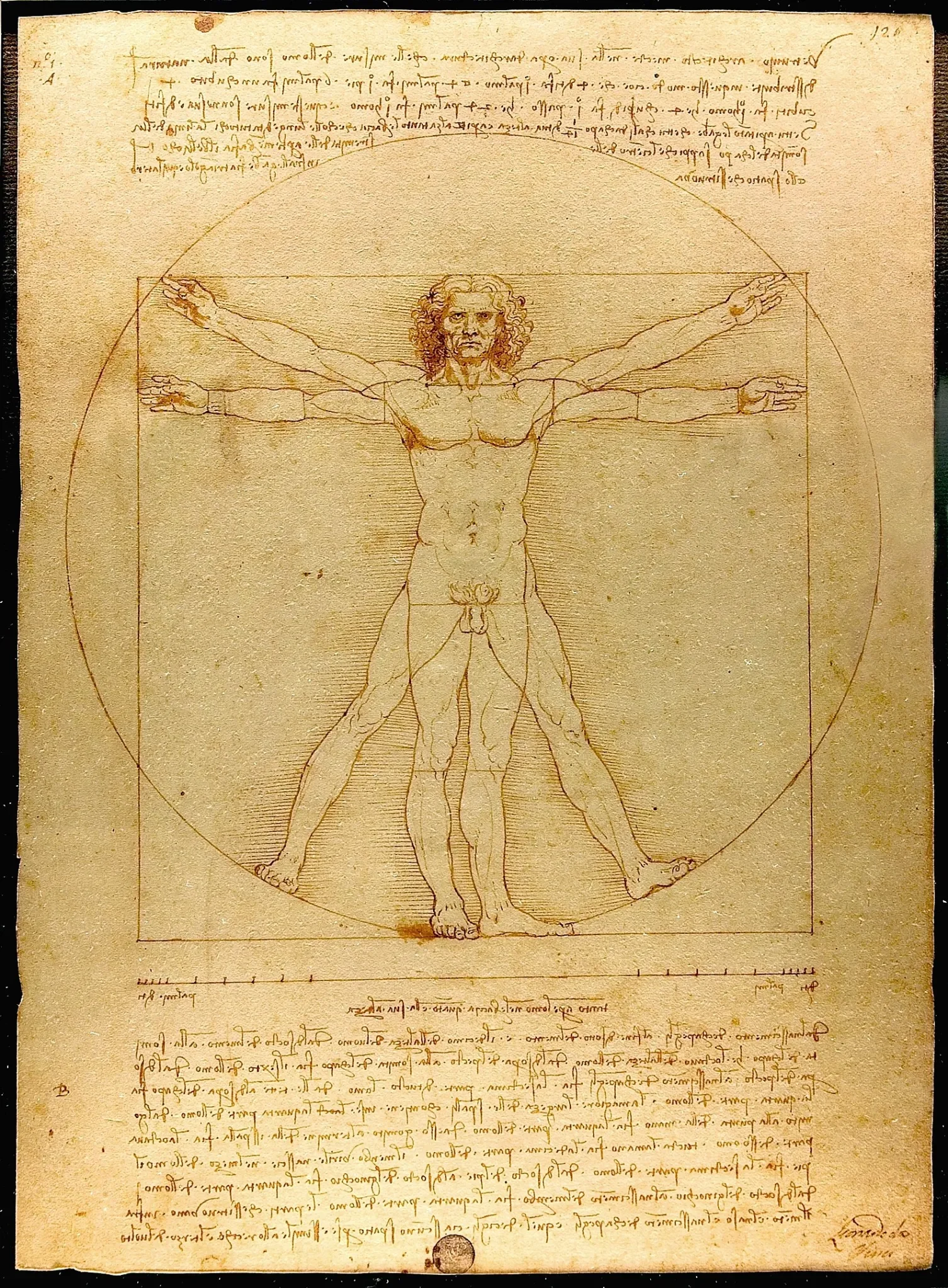
Vitruvian Man, by Leonaardo da Vinci, 1490
And what symbol is used to represent the opposite—the angelic, innocent, and pure? Not only in Christianity but in other cultures and religions as well, just under a different name? A golden circle. The uninterrupted shape of interconnectedness as opposed to the pentagram with its tangles and twists. Interesting how the two are often drawn together too… almost like it’s illustrating the combination of the dual nature in all of us—the light and the dark. Almost like how the two are ever flowing, forever interweaving.
It can also reference the body. This is due to the points the human body makes when taking the pose drawn by Leonardo da Vinci in his famous Vitruvian Man.[1] With this association, it makes sense that it’s the symbol used for the suit of the earth element and that relates to our physical body and environment.
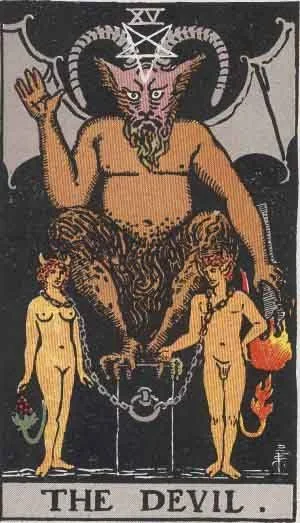
The Devil card, by Pamela Colman Smith, 1909
In the West (Europe and later Colonial/Anglo-America, historically speaking), there were four known and acknowledged elements: air, fire, water, and earth. But in the East (everything not Europe on that side of the world), there are five elements. They include all the same four and add ether, which can roughly be defined as the idea of space, or energy, the in-between. Think of the word ethereal, which means of or relating to the heavens. Therefore, the five-pointed star may at times reference the five elements or elemental magic as adopted into later Wiccan or Neo-Pagan traditions.
To get a six-pointed star, one must simply take two triangles, one with the point facing up and the other facing down, and stack them on top of each other. This too has great historical and cultural significance.
Long before it became the official emblem of the Jewish faith and appeared on the Israeli flag, it carried several significant meanings. It has deep roots within Jewish history, as it was the signet on Solomon’s ring that allowed him to converse with birds and animals and call spirits to do his bidding. The Star, Shield, or Magen of David began being used to identify Jewish communities in Eastern Europe in the 17th century, and was adopted as a religious symbol for the faith in Western Europe in the late 19th century. Then, when it was used to mark Jews in Nazi Germany as a symbol of persecution, it backfired, turning it into a symbol of pride and honor.
Before it became an official emblem of one of the world’s top religions, it was almost universally understood as the marriage of opposites.
The triangle with its point ascending is the symbol for fire in the Western Tradition, the Eastern Tradition, alchemy, and Kabbalah. So too is the symbol for water being a triangle with its point descending. These are also the symbols of male (point up as a phallic symbol) and female (point down mimicking the shape of a woman’s womb). In this way, it also represents the same principles of the “as above, so below” as the Magician’s pose in the first card of the Major Arcana.
It is twelve six-pointed stars that make up the majestic celestial crown of the Empress as well. I will expand on this in the next post.
With seven points in a star, we get to what is known in some circles as the magical star, faerie star, or (my personal favorite) the elven star. It is also called the star of the Seven Sisters after Pleiades, an open star cluster or asterism found in the constellation of Taurus.
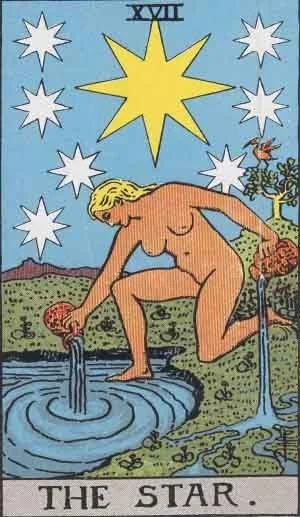
The Star card, by Pamela Colman Smith, 1909
Seven is a sacred number in—that’s right, you guessed it—many cultures and religions, including Christianity, Buddhism, Hinduism, and Islam. There are seven days of the week, seven traditional planets, and seven colors in the rainbow. In math, seven is a prime and perfectly balanced number—1, 2, 3, 4, 5, 6, 7—and it’s comprised of 3 another significant numbers across the globe and religions added to 4 of equal import. The trinity is associated with the divine in several ways. Mind, body, spirit; Father, Son, and Holy Spirit; maiden, mother, crone; three Moirai, or fates; birth, life, death; past, present, future; the list goes on. There are four cardinal directions on earth; four points at the base of a pyramid, making it an optimally stable structure; four elements in Western tradition; four seasons; four faces of Brahma in Hinduism; and a square has four points and four sides.
The lunar cycle is 28 days, which breaks down into 4×7 and 1+2+3+4+5+6+7=28.
Is it any wonder that the seven-rayed star, when combining the deified nature attributed to these celestial gems and the sacred number, would represent the magical and fantastical?
Add another point, and we have the star that represents eternity and regeneration because of its relation to the number eight. The number eight relates to the infinity symbol and the idea of resurrection through its association with Jesus Christ. This is the star Pamela Colman Smith chose for her Star card, and to make it even clearer, she painted eight of them. A theme of the sanctity and mystery of the number eight carried over from the Magician and the Strength cards, whose figures have the infinity symbols crowning their heads. The number eight relates to the cycle of birth, life, death, and rebirth, in that the eighth day in a sequence marks the beginning of a new week. The Star card is the first time we see a solo figure in the Major Arcana in the nude (the Lovers & Devil cards have Adam and Eve naked so that we recognize them as who they are), and it’s the card right after the Tower. Therefore, the Star represents the light that is revealed after the Tower falls. All is bare. All can be seen now, the light through the dark. The rebirth after the death of something.
There are countless more interpretations for stars that I didn’t include here because they didn’t directly relate to the stars used in this tarot deck. And I’m sure I still missed meanings for the ones included. The entire reason I began researching the symbolism of stars was to learn more about the crown The Empress wears with her twelve six-pointed stars, which will be my next post.
If you made it this far, you are a trooper. This was a lot, and I am wordy. I hope you’ll check back for the next post about The Empress’s star crown.
Notes:
In the 15th century, with the rise of Humanism in the Renaissance came the rise of the belief that man was God’s perfect creation. Symmetry in the Renaissance was considered the epitome of perfection and beauty, so by trying to prove that our bodies were perfectly symmetrical, good old Leo was trying to affirm that we are indeed God’s perfection walking around here on earth.
Bibliography:
Becker, Udo. The continuum encyclopedia of symbols. New York, NY: Continuum, 1997. – https://bookshop.org/a/101141/9781667200767
Ferguson, George. Signs & symbols in Christian art. London: Oxford University Press, 1989. – https://bookshop.org/a/101141/9780195014327
Symbolism, (ARAS), Archive for Research in Archetypal. The book of symbols. reflections on archetypal images. Köln: TASCHEN, 2022. – https://bookshop.org/a/101141/9783836514484
Image Credits:
Pamela Colman Smith Tarot Cards. (2024, January 31). https://en.wikipedia.org/wiki/Rider–Waite_Tarot
Vitruvian Man. (2024, March 29). In Wikipedia. https://en.wikipedia.org/wiki/Vitruvian_Man
