
Tarot Symbolism & The Masculine
“He is executive and realization, the power of this world, here clothed with the highest of its natural attributes.”
—Arthur Edward Waite, The Emperor, The Pictorial Key to the Tarot
What's With All The Penises?
My bachelor’s in art history means I spent a great deal of time in youth studying the history and mythology of Greece. Take any survey art history class in America and you will too. The Greeks are kind of a big deal in that field of study. They made a lot of contributions to Western art. Like, a lot.
But when my husband and I honeymooned in Greece, no one warned us about the penises.
I knew it was a symbol—in any culture I’ve studied—representing male vitality, fertility, virility, strength, and power. For the Greeks it was a symbol of Dionysus, who was originally the god of fertility and later became known as the god of wine and pleasure. To the Romans, he was Bacchus—from which we get the term Bacchanalia (i.e., a party with a lot of drinking and shenanigans).
In ancient Greece, phalluses were also erected as statues and in bas relief for protection and again as fertility symbols. Many were also painted on Greek urns, wine jugs, and other ceramics. In fact, if you want to see some ancient erotica, I recommend you do an image search on Google for “Ancient Greece and the Phallus.” You’ll see what I mean.
But back to my honeymoon in modern-day Greece.
When I saw all the penises, I was pleasantly surprised to see that the Greeks had held on to that part of their heritage and were still proudly displaying phalluses wherever we went. My husband? He was far less prepared for the amount of male genitalia he was going to be seeing while honeymooning with his new bride.
That being said, the Greeks aren’t the only society who love penises. Though they remain the only country I’ve visited with so many souvenirs in the shape of them (except for maybe Brussels and their fountain with the little peeing boy which is also everywhere). Still, one of our favorite things to do when we have friends over is pull out our hand-painted, penis-shaped bottle opener and give it to them to open their beer. It’s always a firm conversation starter.
Architectural Penises
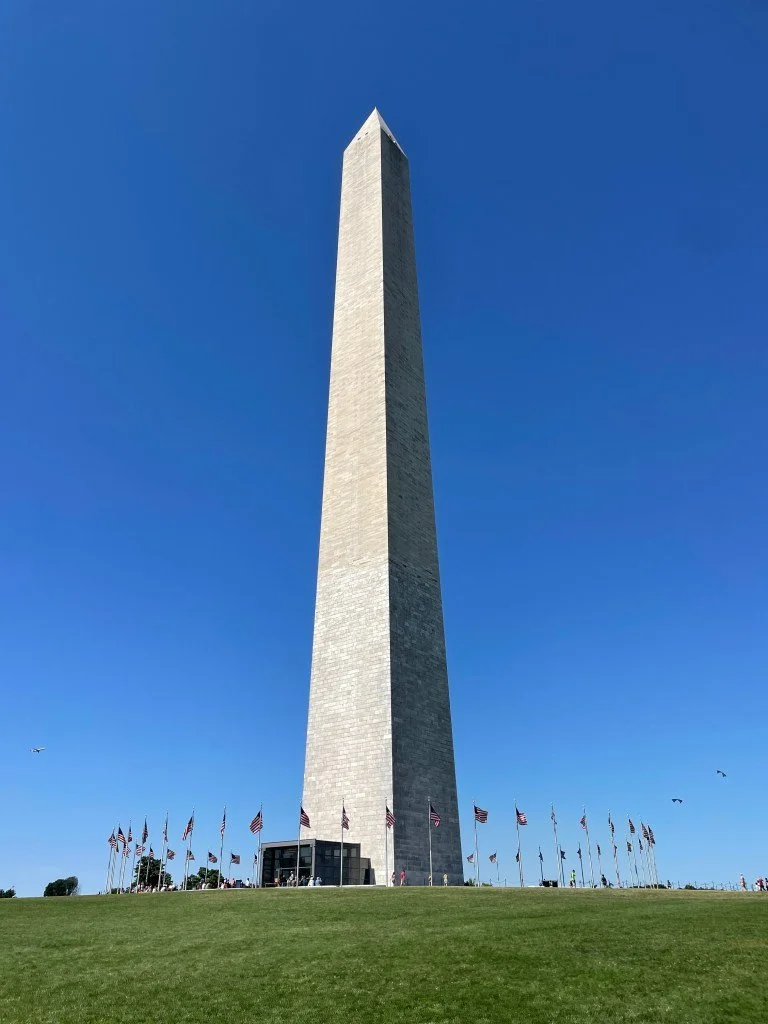
But let’s look at how we still worship the almighty phallus in our recent history. Think about the Empire State Building, the Chrysler Building, the Sears Tower, the Burj Khalifa. Look at the shape of these structures that have all been called the “world’s tallest building” at some point. Think of the global competition throughout history for a country to be able to declare, “ours is biggest!”
And let's consider obelisks. When I think of obelisks, my mind goes to Egypt and the ones transported from there to Rome and other European nations over time. And while those built by ancient Egyptians were erected out of reverence for their dead Pharaohs and to honor their gods, there’s no denying the shape reminds us of an erect penis. And when it came time for Americans to honor our first president (a man), what design was ultimately chosen? An oversized phallus piercing the sky and letting visitors know, “hey, we are strong with big …” Even according to Smithsonian Magazine, “The real point of the Washington Monument seems to be, well, its point.” And it just so happens to be the tallest obelisk in the world.
If phallus sculptures outside of Greek towns signified their power and strength, what were early Americans trying to say about America with our erection of this giant phallic-shaped memorial?
Okay, if we’ve had enough of the penis talk, I think I’ll get to my point (see what I did there?).
Let's Talk Masculine Energy, Not Male Genitalia
And that point is that masculinity throughout history has been forever tied up symbolically with the penis.
(And I didn’t even get into other cultures like India. To learn more about what I mean about that, Google “India and Lingam.”)
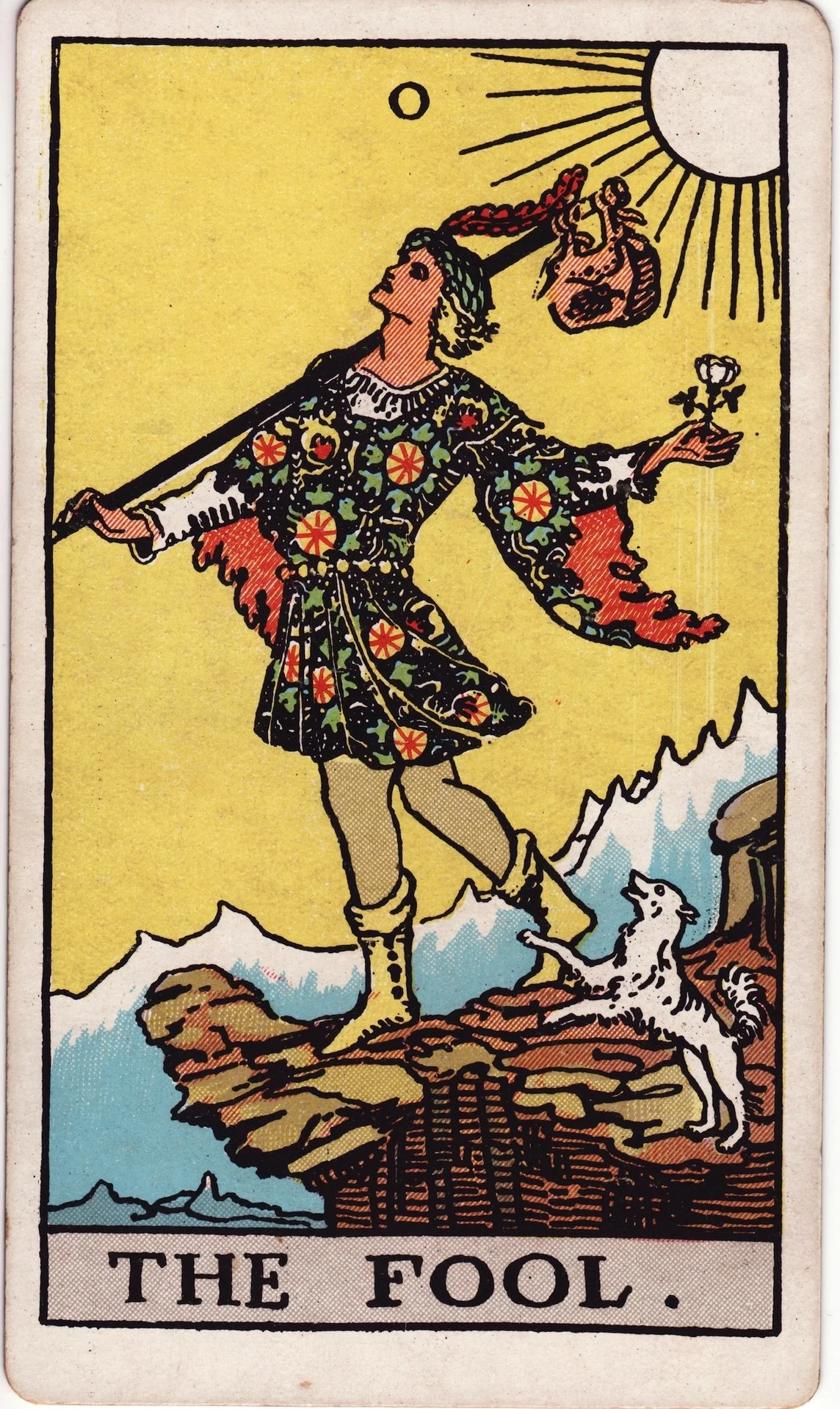
The Fool card, Pamela Colman Smith, 1909.
But masculine energy, especially the divine masculine, isn’t only related to maleness. A vagina-born person can carry a whole lotta masculine energy. A penis-born person can be feminine-energy dominant. Because the archetypal energy of the masculine has nothing to do with how big your member is or if you were even born with one.
It’s the yang side of things.
The active energy to creativity—without the seed and the sun, the flowers will not grow.
It’s the left side of the brain.
Think of the corporate atmosphere as analytical and logical, versus the homeopathic environment where empathy and intuition reign.
From my perspective of the tarot based in the Smith-Waite tradition, we are not introduced to anything truly masculine until we get to the Emperor.
What? How can that be, you ask? The Fool, the Magician… aren’t they male?
Well, I believe when looking at Pamela Colman Smith’s deck as the foundation for the Anglo-American tradition of tarot, no. The Fool and the Magician are androgynous characters; however, their cards possess a yang/solar energy in their environment. Then we get into the feminine goddesses of the High Priestess and the Empress. Then we meet the Emperor and the Hierophant, and here we encounter masculine energy and character.
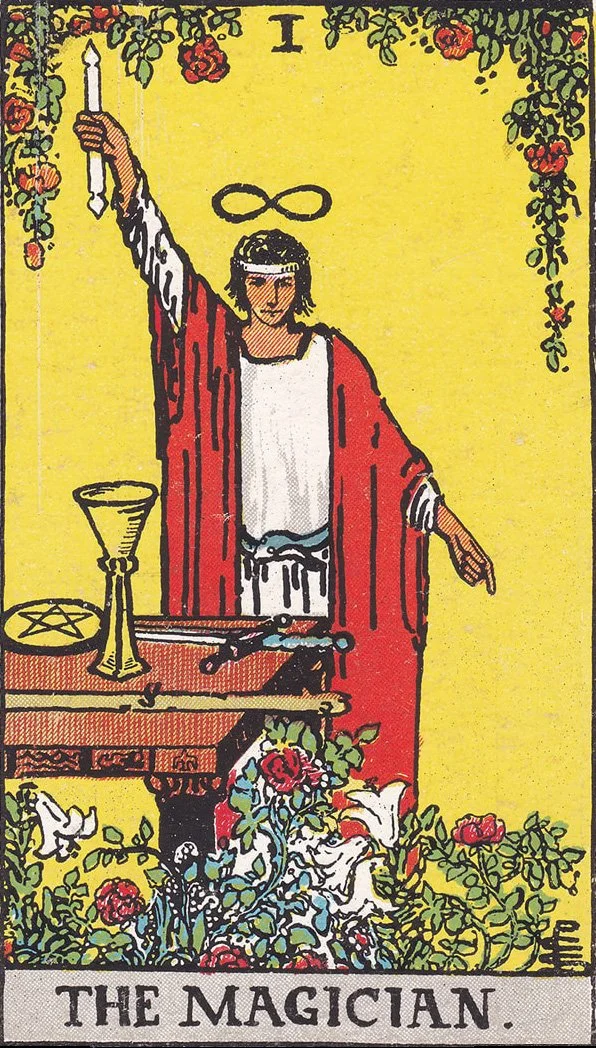
The Magician card, Pamela Colman Smith, 1909
How very interesting…
First, there’s an undefined nature. Then feminine. Then masculine. Hmmmm.
And even in reading Waite’s description, he introduces us to our first quintessentially masculine and male personages by describing them in relation to the women who came before them.
As if to say it is from the feminine that all life is born, but not without the active energy brought to us through the masculine.
Kind of a different take from that whole Biblical-Genesis tale of the male God creating the male Adam first and then using his rib to create the woman Eve, huh?
Yes, because we all possess masculine energy, we are all in need of that side to keep the cycles of life going, and when it is separated from our contemporary problems with modern-day toxic masculinity, it is a vital piece of our life force.
What’s the difference between toxic masculinity and a healthy dose of the divine masculine? The former is the concept of big penis = strong male. The latter is like Waite’s description, powerful in executive realization. In other words, someone comfortable in their skin who makes executive decisions from a place of wisdom and confidence, not from needing to prove themself or assert their dominance.
The Emperor & Hierophant
So, let’s look at the Emperor and then the Hierophant—our masculine counterparts to the Empress and the High Priestess. Much like their female forerunners who are two sides of the same Great Goddess coin, these gentlemen are also two sides of the same masculine archetype. The Emperor is the warrior-king and ruler of the domestic, the Hierophant the spiritual sage and leader to the spiritual.
When one sees the Emperor card, often what stands out are the four rams’ heads that adorn his throne. Next, the eye may be drawn to the scepter and orb, and most make immediate note of the red hues dominating the scene. His warrior-status is denoted by his armored feet and legs peeking out.
As the color of fire, red is a masculine color by nature. Think of the alchemical symbol for fire which is also the most basic sign for male—∆—the triangle with point facing up, a rudimentary phallus. Red is also the color of the planet Mars. Mars is the Roman equivalent to the Greek god Ares and is the ruling planet for the Zodiac sign Aries. The Ram’s head is associated with both gods and the astrological correspondence. There is a slight energetic difference between the Roman god Mars and his Greek predecessor.
Emperor, The Warrior-King
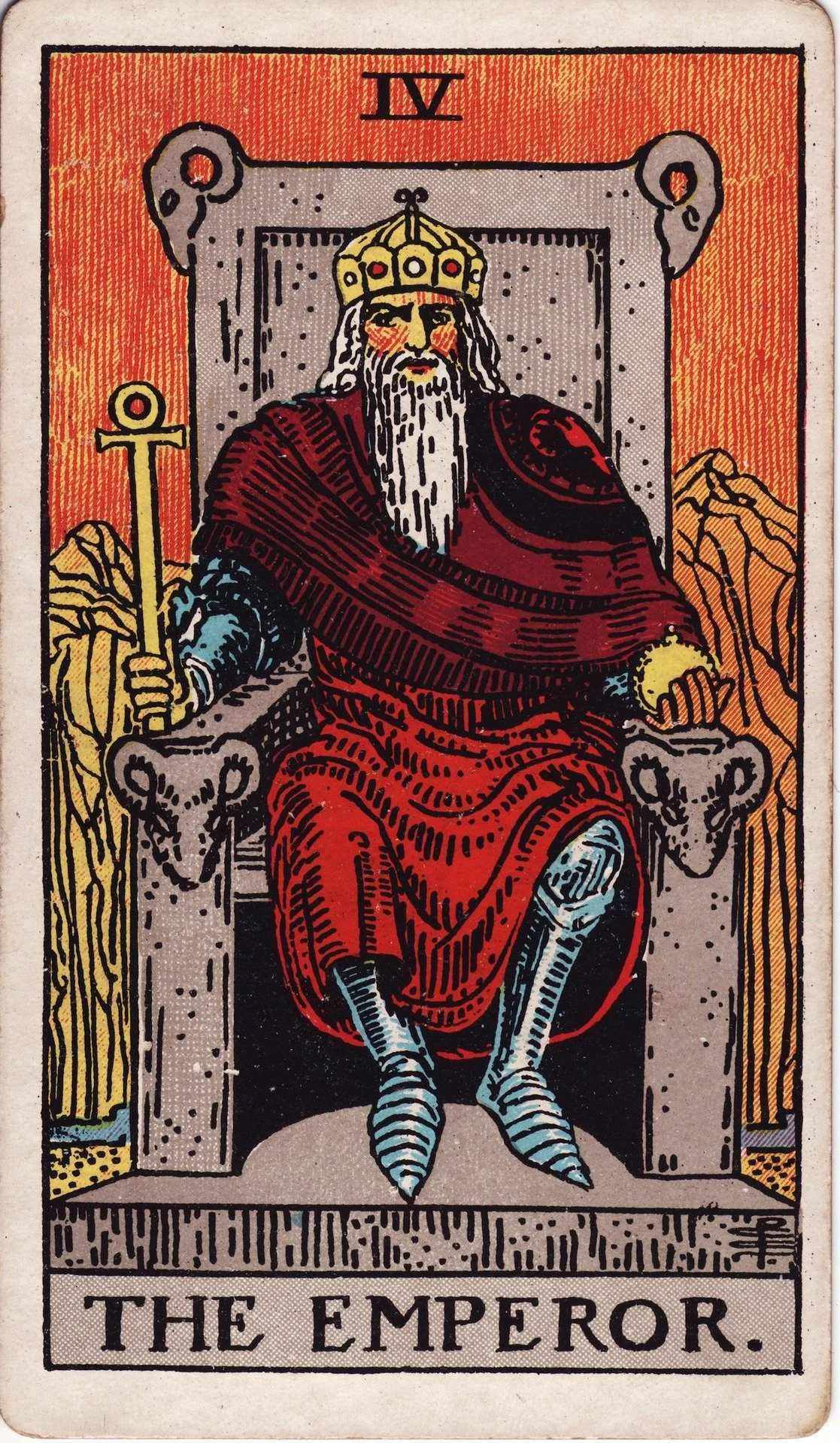
The Emperor card, Pamela Colman Smith, 1909
Ares was an aggressive and wild war god. He was a kick-the-door-down and go in guns-blazing type of god. Mars is much more like a Roman emperor, or Caesar. Rome didn’t conquer their sizable territory by blazing in. No, there was calculation, planning, training, and order to the Roman military that explains our continued fascination and admiration for this time in history and culture. Not only that, but the Roman emperors were wise to allow the people they were conquering to hold on to their culture, their deities, their holidays, as long as they paid fealty to Rome and became Roman citizens. It made assimilating them into Roman society all the more effective.
This is the energy of the Emperor card, ruled by Mars. Because this is the energy of Mars, the warrior-god.
Regarding the Emperor’s energy as it relates to the Empress Waite writes:
“It should be understood that this card and that of the Empress do not precisely represent the condition of married life, though this state is implied. On the surface as I have indicated, they stand for mundane royalty, uplifted on the seats of the mighty; but above this there is the suggestion of another presence. They signify also—and the male figure especially—the higher kingship, occupying the intellectual throne. Hereof is the lordship of thought rather than of the animal world.”
Essentially, he’s declaring them as related but not married and as the archetype of higher levels of their positions—creative nature (Empress) and rational reason (Emperor). Therefore, ascribing the creative nature within us all to being ruled by the feminine and the intellectual ability for logic, the masculine.
The Emperor-Empress Connection
Another way to look at it is the Empress is as pure nature. If human beings don’t come in, tame it, and carve out a space for civilization, it will continue to grow unfettered and become wild enough to hinder our existence. When humans want to tame the land and create man-made dwellings, it is, in a way, a conquering of the wildness of nature around them. However, a caveat has been ignored for millennia, especially in Western culture. When, and only when, this masculine-dominant need to create that which does not grow by nature (Emperor) works in harmony with pure nature (Empress) and does not exceed into attempting to eradicate the wildness, we thrive. But it becomes toxic when the masculine energy becomes about control and, in so doing, then tries to stamp out all the wild, not allowing for any freedom of flow.
Feminine is flow. Masculine creates the path to direct the flow. When they work together, they create a fertile land of abundance. When man-made creation blocks the flow, though, repression occurs. Repression in humans leads to illness, addiction, and harmful behaviors. Repression of the earth’s energy is doing the same.
But now, to step down off my soapbox. Let’s move on.
Penises Again, Last Time, I Promise!
Also seated on a throne that looks to be made of stone, between two columns resembling those welcoming visitors to St. Peter’s Basilica (though much shorter), robed in red and adorned with regalia too, is the Hierophant. Both figures hold a sceptre. The Emperor holds the Crux ansata (which we will take a deeper look at soon); his sage-ruler companion holds a staff topped with the Papal Cross. On a surface-level reading, these scepters identify the ruler and his role. The Emperor also holds the orb, and the Hierophant has the crossed keys at his feet. British kings are coronated with the sceptre and orb, Catholic popes carry the papal cross, and the keys are their symbol as related to the metaphorical keys given to St. Peter by Jesus prior to his crucifixion. But at their most basic, sceptres are phallic in shape; they are staffs, rods… another symbol of a male ruler’s sovereignty in the shape that reminds us of his penis.
I will need to look into this further, but I find it interesting and telling that the Empress also holds a “sceptre” although hers is the size of a hairbrush in her hand and topped with an orb. I’m curious whether there’s an explanation, and whether that would debunk my assertion that the scepters are present to reinforce the phallic nature of masculine energy. To be continued…
Hierophant The Sage-Ruler
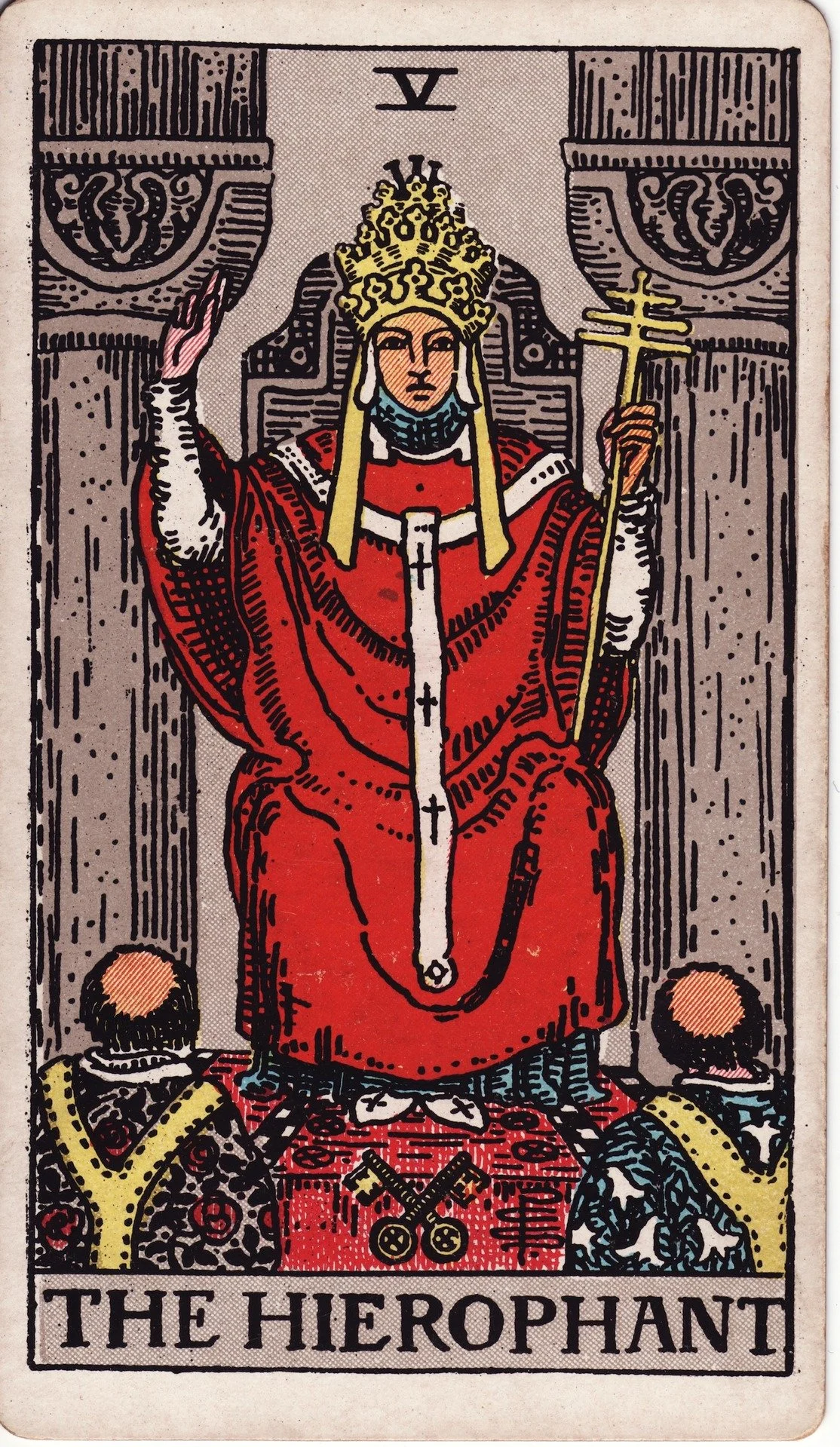
The Hierophant card, Pamela Colman Smith, 1909
With his left hand, the Hierophant gestures a symbol of blessing. Is he bringing together some kind of union? Are the figures kneeling at his feet (who have the tonsure haircuts of medieval Catholic monks) initiates he is giving his benediction? Either way, there’s a lot of twos in the Hierophant’s card—two columns, a symbol between heaven and earth (note the Emperor does not have columns, he is in front of mountains, further asserting his earthly status, and the High Priestess also sits between two columns, while the Empress is in nature), two keys, two fingers raised, two acolytes at his feet.
Waite calls this gesture a “well-known ecclesiastical sign,” and Pamela Colman Smith’s biographer, Stuart Kaplan, points out that this is the same gesture often seen in depictions of “Christ Pantocrator, the risen Christ or all-powerful or Ruler over All.” This suggests that the resurrected Christ energy is depicted here. This would complement his feminine other half, who has her own symbolism referring to resurrection.
In essence, the High Priestess is pure wisdom, and the Hierophant is man’s ability to teach and preach her wisdom here on earth.
Waite also describes the Hierophant’s card from the perspective of his relation to the High Priestess, same as he did with the Emperor-Empress connection:
“He wears the triple crown and is seated between two pillars, but they are not those of the Temple which is guarded by the High Priestess…It is noticeable in this connexion [sic] that the High Priestess makes no sign…He is the ruling power of the external religion, as the High Priestess is the prevailing genius of the esoteric, withdrawn power.”
With the Hierophant we also see a nod to the Magician’s conscious yang energy. The red robes and similar hand gestures suggest both are in tune with higher wisdom and act as channels for it from above into the world. Whereas the High Priestess is the ever-knowing that is concealed, and she keeps it that way.
How This All Relates to the Tarot
So, what, if anything, do we learn from examining the masculine archetypes as found in the Emperor and Hierophant?
That the tarot suggests that the Fool’s journey of individuation is one borne out of undefined nature, then feminine and yin, mystery and wild, raw power of creation, and steps into the masculine, yang, sense of order and direction.
Two significant male archetypes who were weighty enough to earn themselves their own distinct place in the Major Arcana are:
The warrior-king
The sage
Feminine energy—while considered the passive side—is shown in the tarot as being full of flow and growth.
Think of how the High Priestess’s robe flows into the water, the water ripples behind her, and the veil she sits in front of has the hint of a breeze; then consider the folds of the Empress’s gown, and how the trees and grain suggest a swaying around her.
The masculine, which is said to be the active side, is shown as stable and solid
See the mountains behind the emperor; look at the hard surfaces of their thrones and the columns around the Hierophant, the armor the Emperor wears and their helmet-like crowns.
Was PCS telling us that the feminine nature is one of wild spirit? And that the masculine is what contains it? And in perfect harmony, this creates sympatico relationships, but let one become unbalanced, and chaos will ensue?
She was, after all, a Suffragist, and we may be seeing a little bit of her opinion here on the effects of male constructs and patriarchal society on the feminine spirit.
This may be why these are two of my least favorite cards in the deck, and why it was a difficult start to write about masculinity for me. Because I know all too well what it is like to have a difficult relationship with your masculine side.
So then, what could it mean when this card comes up in a reading?
Aside from a million things depending on how you read, the spread you use, the deck you choose, and where they appear, some general readings are:
The Emperor suggests rational thinking and strategic planning.
He rules decisions based on wisdom from walking the walk.
He is the ultimate businessman.
He may be there to represent your father or father-figure, or husband.
The Hierophant is a teacher or leader.
He may appear when you’re following rules too rigidly, basing too many of your decisions on tradition and guidelines.
He may be there to suggest you are in a leadership role and that it is your purpose to teach others.
He may suggest a mentor.
This card can also suggest a “papal union,” so to speak, and may refer to an initiation of sorts into a belief system or the bringing about of two people who may or may not be a good match.
If either of these cards is your tarot personality/soul or life influencer cards, then they may reveal special significance in a reading for you or your querent.
I am currently working on creating guides about the Soul & Influencer cards in tarot, and will add them to my Patreon shop and make them available to Patrons!
As always, if you’ve made it this far with me, I love you bunches. Until next time…
♥️ BB Soto
Bibliography
CrashCourse. 2024. “World History Encyclopedia.” Worldhistory.org. 2024. https://www.worldhistory.org/video/1321/archetypes-and-male-divinities-crash-course-world/.
Eschner, Kat. 2016. “The Washington Monument Looks like an Obelisk because of Egyptomania.” Smithsonian Magazine. Smithsonian Magazine. December 6, 2016. https://www.smithsonianmag.com/smart-news/washington-monument-built-egyptomaniacs-180961314/.
Moore, Robert L., and Douglas Gillette. King, warrior, magician, lover. San Francisco: Harper, 1990.
https://bookshop.org/a/101141/9780062506061
Nichols, Sallie, and Mary K. Greer. Tarot and the Archetypal Journey: The Jungian Path from Darkness to Light. Newburyport, MA: Weiser Books, an imprint of Red Wheel/Weiser, LLC, 2019. https://bookshop.org/a/101141/9781578636594
Pollack, Rachel. Seventy-Eight Degrees of Wisdom: A Tarot Journey to Self-Awareness. Third edition. Newburyport, MA: Weiser Books, 2019. https://bookshop.org/a/101141/9781578636655
Satya Doyle Byock. 2023. “The Post-Jungian Masculine Archetypes Are Not a Thing.” Substack.com. Self & Society. July 11, 2023. https://satyadoylebyock.substack.com/p/the-post-jungian-masculine-archetypes.
Waite, Arthur. The Pictorial Key to the Tarot. US Games Inc., 2009. https://bookshop.org/a/101141/9780486442556
Wikipedia Contributors. 2024. “Jungian Archetypes.” Wikipedia. Wikimedia Foundation. April 28, 2024. https://en.wikipedia.org/wiki/Jungian_archetypes
Image Credits:
All Images not photographed by BB Soto are downloaded from Wikipedia.
