
Tarot Symbolism: The Magician
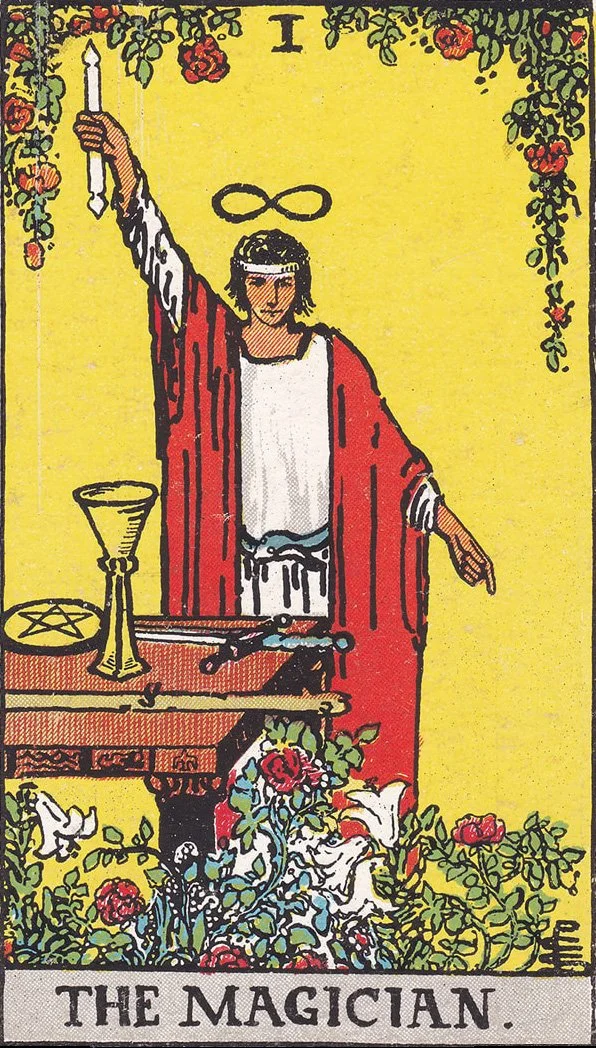
The Magician (tarot card). (2023, December 23). In Wikipedia.
“The suggestion throughout is therefore the possession and communication of the Powers and Gifts of the Spirit.
—A.E. Waite, The Pictorial Key to the Tarot, 1909
Striking yellow, rich red, and pops of white catch the eye in the first official card of the Major Arcana. The Magician — unlike the insensate Fool who both begins and ends the Major Arcana — is standing in the conscious plane. Where the sun, representing consciousness, rose in the sky above and behind the meandering Fool, the Magician here is surrounded by the light of awareness. They are robed in pure intentions (white) and sparked with the life force, the passion, the vitality to manifest their destiny (red). The tools of the four suits, the four elements, and the four states of being are laid out before them now. They are the alchemist experimenting with creating the possibilities of creating through divine awareness.
Channeling that power, pointing their double-ended candle to the heavens with their right hand, their left forefinger directs the action to the earth.
That which is Below corresponds to that which is Above, and that which is Above, corresponds to that which is Below, to accomplish the miracles of the One Thing.
—The Emerald Tablet of Hermes Trismegistus; from Jabir ibn Hayyan translations via sacred-texts.com
This same macrocosm to microcosm to macrocosm flow of interconnectedness is mirrored in the infinity symbol floating above the Magician’s head. Though Waite calls this the “mysterious sign of the Holy Spirit, the sign of life, like an endless cord, forming the figure 8 in a horizontal position.” In this card we get a direct introduction to the alchemical success Pamela Colman Smith (the artist of the deck), and Arthur Edward Waite (the author of The Pictorial Key to the Tarot) created with their deck.
The Smith-Waite Fool was rife with recognizable symbols that would’ve spoken volumes to novice readers compared to their predecessors, but here and now with their Magician we have the development of a rich visual language that is the union of past and present and future.
The link to the Holy Spirit through the horizontal 8, the specific identification of the roses and lilies as being the biblical “flos campi et liliium convallium.” and the breakdown we receive from Waite about the direct connection between the number 8 and Christ as believed by the more mysterious Christian sects—all introduced early 20th century tarot readers to a visual language they would’ve recognized from simply living as the descendants of the Grecco-Roman-Medieval people.
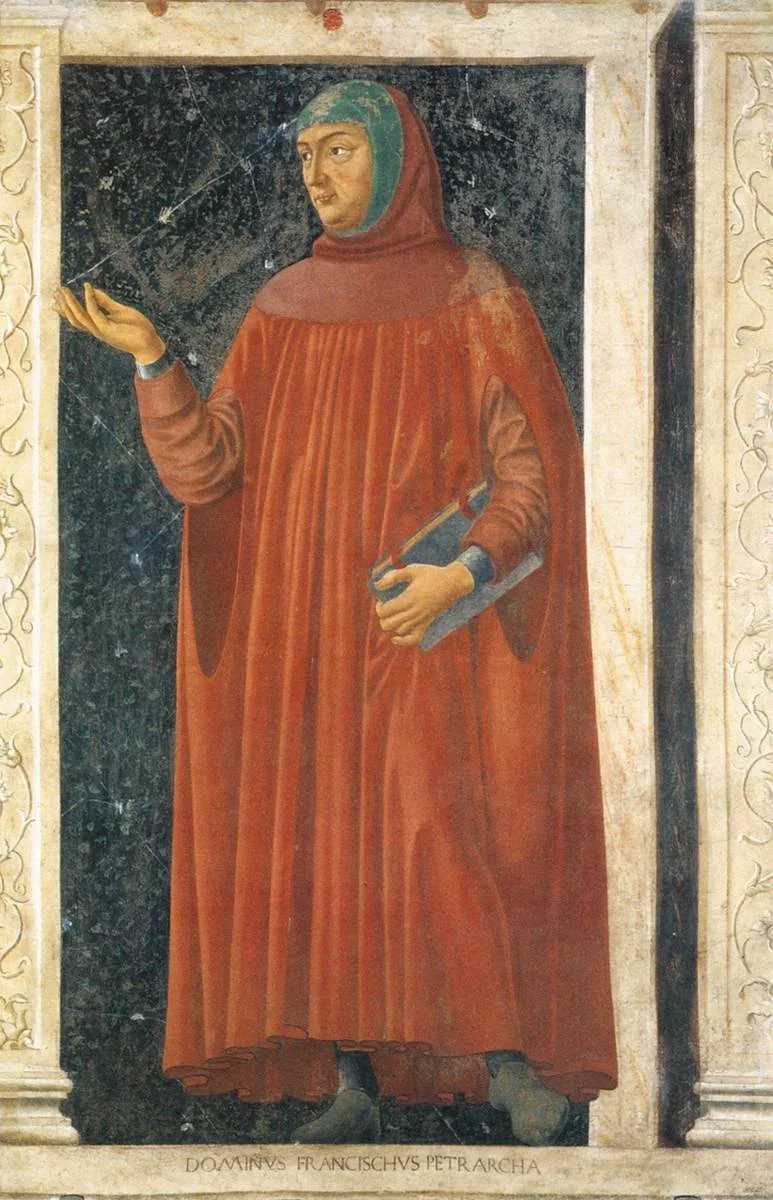
Petrarch (1304–1374), who conceived the idea of a European “Dark Age”. From Cycle of Famous Men and Women, Andrea di Bartolo di Bargilla, c. 1450
Classical education, while lost during what is inaccurately called the “dark ages” due to literacy waning among the masses, was maintained and revived multiple times throughout medieval European history. Most well-known was during the Renaissance period, so named because it was the time when Classical (Greco-Roman) knowledge was “re-birthed.”[1]
Early 20th-century Europeans did not think of themselves as part of any distinct time period in history separate from their Renaissance ancestors. To them, they were on the same track of evolution from the period when Plato and Aristotle, Aphrodite and Poseidon were lost to the period when people knew them to be the polytheistic precursors to their biblical counterparts. In fact, the Middle Ages was about one thousand years of theological reasoning trying to reconcile the fact that early Christians believed time started with Christ’s birth and the revelations that, no, there had been a great civilization predating Him and those people had worshipped other gods. But, since it was considered an honor and a privilege to be descended from these mystical and mythical beings who’d left behind the ruins of such advanced architectural and technological knowledge, they needed a way to make it okay that their Greco-Roman ancestors worshipped deities other than the One True God.
If you’re interested in the many ways theologians found to make pre-biblical gods and goddesses prophetic of the Christian pantheon, I highly recommend researching it. It’s wild, and the ways that philosophical thought has carried down even to our modern society here in America will blow your mind.
For today’s discussion on the Magician card, what’s important to know about all that history is that the introduction of Christian Iconography into the tarot was:
a) intentional on behalf of Pamela Colman Smith & Arthur Waite;
b) would’ve been like an artist today taking the tarot of Smith-Waite and using symbols from contemporary mainstream pop media recognizable by the everyday American and creating a new deck with the same meanings but different pictures. (I actually believe The Light Seer’s Tarot does an excellent job at just this!)
c) The thing about Christian Iconography is it usually ties back to its Classical or antique roots, and therefore, will have fluid meanings that have made it possible to alchemize into its very own tarot symbolic language.
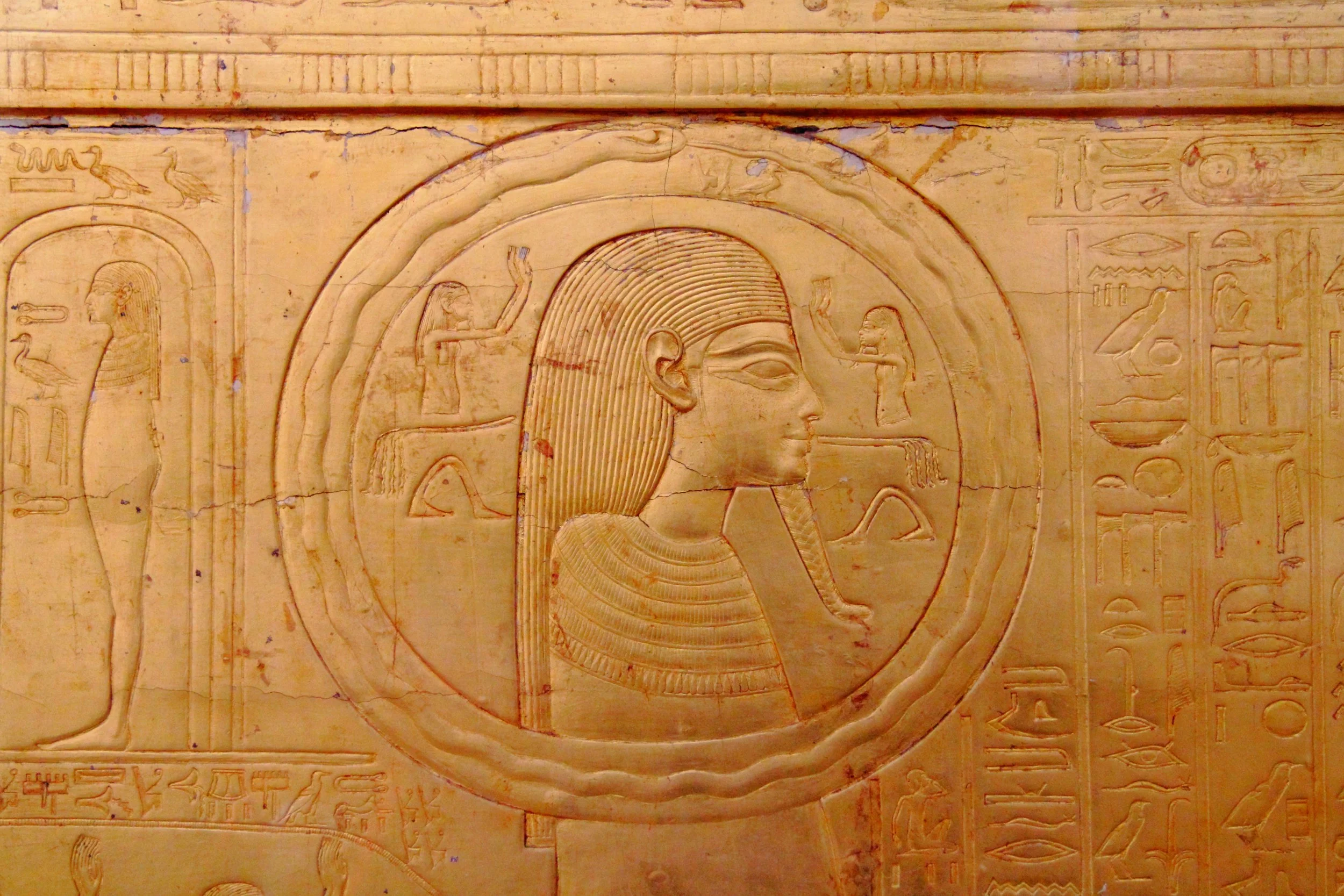
First known representation of the ouroboros, on one of the shrines enclosing the sarcophagus of Tutankhamun
Back to that macrocosm to microcosm to macrocosm theme as seen in the Magician’s gesture, the infinity symbol, and also the “serpent-cincture” around the figure’s waist, the snake eating its own tail, or the ouroboros.
As with the other significant symbols building on the overarching theme of manifestation that is the Magician card, the Ouroboros or Uroboros is layered in meanings and origins. Ancient Egyptian, Greek, Roman, and Norse representations of snakes or dragons eating their own tails exist. Snakes, or serpents, and their mythological cousins — the dragon — who shed their skin and emerge reborn, transformed and yet the same, are a natural symbol existing in nature for the cyclical nature of life of birth-death-rebirth.
Their long serpentine bodies lend themselves well to being represented in the circular shape; also, sometimes the snake (or two snakes) create the infinity symbol as they slither around to bite their own tail. At other times, two snakes wrap themselves around a staff, intertwining; the combination of opposites—the famed Caduceus, sometimes associated with the medical symbol, sometimes thought to be mistakenly used in this context (see Rod of Asclepius).

The Caduceus, symbol of God Ningishzida, on the libation vase of Sumerian ruler Gudea, c. 2100 BCE.
Though the Caduceus is not specifically present in the Magician’s card imagery, it is related in so many ways. According to Adele Nozedar in The Element Encyclopedia of Secret Signs & Symbols:
As the serpents scroll around the wand, they form the figure-of-eight shape, or infinity symbol, which stands for completeness and perfection.
Part of the infinity symbol is the circle, ultimately representing the cosmos, the spirit, and unity.
All these elements combined make for a powerful symbol that has altered very little over the millennia. Together, they adds up to supernatural power and hidden wisdom, messages from the spiritual realms, authority, the cosmos and infinity, and the pairing of opposites in harmony and unity.
For all of these reasons, the snakes are closely tied with the alchemical concept of merging opposites and of the ‘as above so below/as within so without/as the universe so the soul’ concept derived from the Emerald Tablet. Alchemists themselves believed the process to be only possible with the manifestation of the spiritual truths as given to the alchemist from God directly and not to be known by the masses.
Which leads into the understanding as to why the Magician is surrounded by roses, and standing ‘sub-rosa’ — an ancient designation for anything the be kept secret would happen under the rose, i.e. sub rosa. This is a symbolic practice dating back to ancient Greece and still present today in architectural designs (think of any patterned ceiling where the decorations are in the form of roses or abstractions of it).
To know what happens sub rosa is to be on the inside, in the know, an initiate, one who transmutes the mysteries and secrets of the Universe into the realities of the earth. And the Magician is that person who is on the inside. They know the secrets that happen sub rosa. They are ready to channel their divine nature into being. So while there are countless sub meanings, meanings beyond meanings, and personal interpretations to be had when this card appears, the intention by the artist and co-creator is clear. This is the manifestation card.
Notes
[1] From French renaissance, from re- ‘back, again’ + naissance ‘birth’ (from Latin nascentia, from nasci ‘be born’). The period from the 14th to 16th centuries is so named with a capital ‘R’ — the Renaissance — as the specific time in which the interest in Classical mythology, beliefs, history, and philosophy were renewed.
Bibliography
Daly, Jack. “The Union of Opposites: Carl Jung, Folklore, and the Caduceus and Ouroboros in Alchemy.” DigitalCommons@USU, 2020. https://digitalcommons.usu.edu/gradreports/1488.
Ferguson, George. Signs & symbols in Christian art. London: Oxford University Press, 1989. https://bookshop.org/a/101141/9780195014327
Jack, Father Rob. “Bride in Song of Songs as a Type of Mary.” Bride in Song of Songs as a Type of Mary : University of Dayton, Ohio, January 17, 2024. https://udayton.edu/imri/mary/b/bride-in-song-of-songs-as-a-type-of-mary.php.
Kaplan, Stuart R., Mary Katherine Greer, Elizabeth Foley O’Connor, and Melinda Boyd Parsons. Pamela Colman Smith: The untold story. Stamford , CT: U.S. Games Systems, Inc., 2018. – https://bookshop.org/a/101141/9781572819122
Nozedar, Adele. The element encyclopedia of secret signs and symbols: The ultimate A-Z guide from Alchemy to the zodiac. London, UK: HarperElement, 2008. – https://bookshop.org/a/101141/9781667200767
Symbolism, (ARAS), Archive for Research in Archetypal. The book of symbols. reflections on archetypal images. Köln: TASCHEN, 2022. – https://bookshop.org/a/101141/9783836514484
Waite, Arthur Edward. The pictorial key to the tarot. Mineola, NY: Dover Publications, 2005. https://bookshop.org/a/101141/9780486442556
Image Credits:
The Magician (tarot card). (2023, December 23). In Wikipedia. https://en.wikipedia.org/wiki/The_Magician_(tarot_card)
Ouroboros. (2024, February 3). In Wikipedia. https://en.wikipedia.org/wiki/Ouroboros
Dark Ages (historiography). (2024, February 13). In Wikipedia. https://en.wikipedia.org/wiki/Dark_Ages_(historiography)
Caduceus. (2024, February 13). In Wikipedia. https://en.wikipedia.org/wiki/Caduceus
