
Tarot Symbolism: The Rose (& Lily)
Above all, roses signify love, in all its earthly and heavenly hues.
—The Book of Symbols: Reflections on Archetypal Images
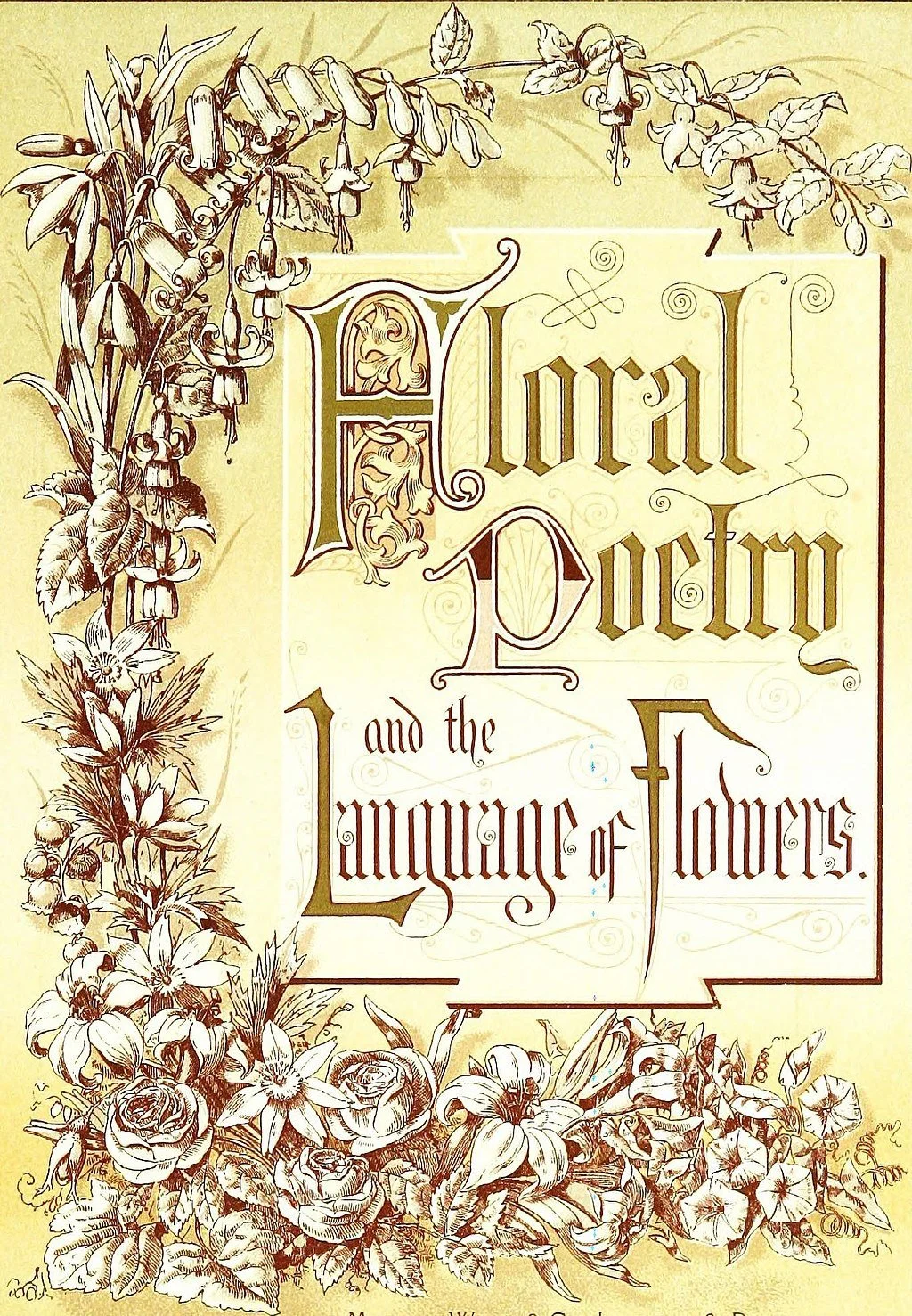
Title page, Floral Poetry and the Language of Flowers, ca. 1877.
In Victorian England (1837-1901), sending flowers as coded messages became quite a popular form of communication for the upper class. Used to circumvent the rigid social conventions of the time that strictly prohibited direct emotional expression, the language of flowers didn't originate with 19th-century Britons, but it blossomed beyond belief.
From answering yes or no, or letting a friend know their letter was received, to flirtations and declarations of love, the flower itself, whether it was singular or in a bouquet, down to which hand was used to deliver the flowers, all held significance.
So, would it surprise anyone to know that red roses meant passion and romantic love in a number of ways?
I'm pretty sure anyone raised in America who leaves their house, turns on their TV, looks at social media, or has any kind of interaction with the outside world during the early weeks of February would not be. After all, red roses account for 70% of flower sales leading up to Valentine’s Day.
But have you ever wondered why red roses are the symbol of love?
It could be that, going as far back as ancient Greece, the rose was associated with Aphrodite, the goddess of love. At the heart of it all, I believe that the blooms being as beautiful as they are, the fragrance as alluring, it was destined for these flowers to grace the world with this symbolic meaning.
Red and white roses also have a specific tie to the Greek (and later Roman) goddess of love. It is said that the first roses were white until Aphrodite pricked her ankle on one of the thorns and her blood stained them red.
Throughout history and across cultures, red is associated with passion, love, the heart, etc., because it is the color of blood. Also a color associated with fire. What's more passionate than the element that can consume everything in its path until it's burned out?
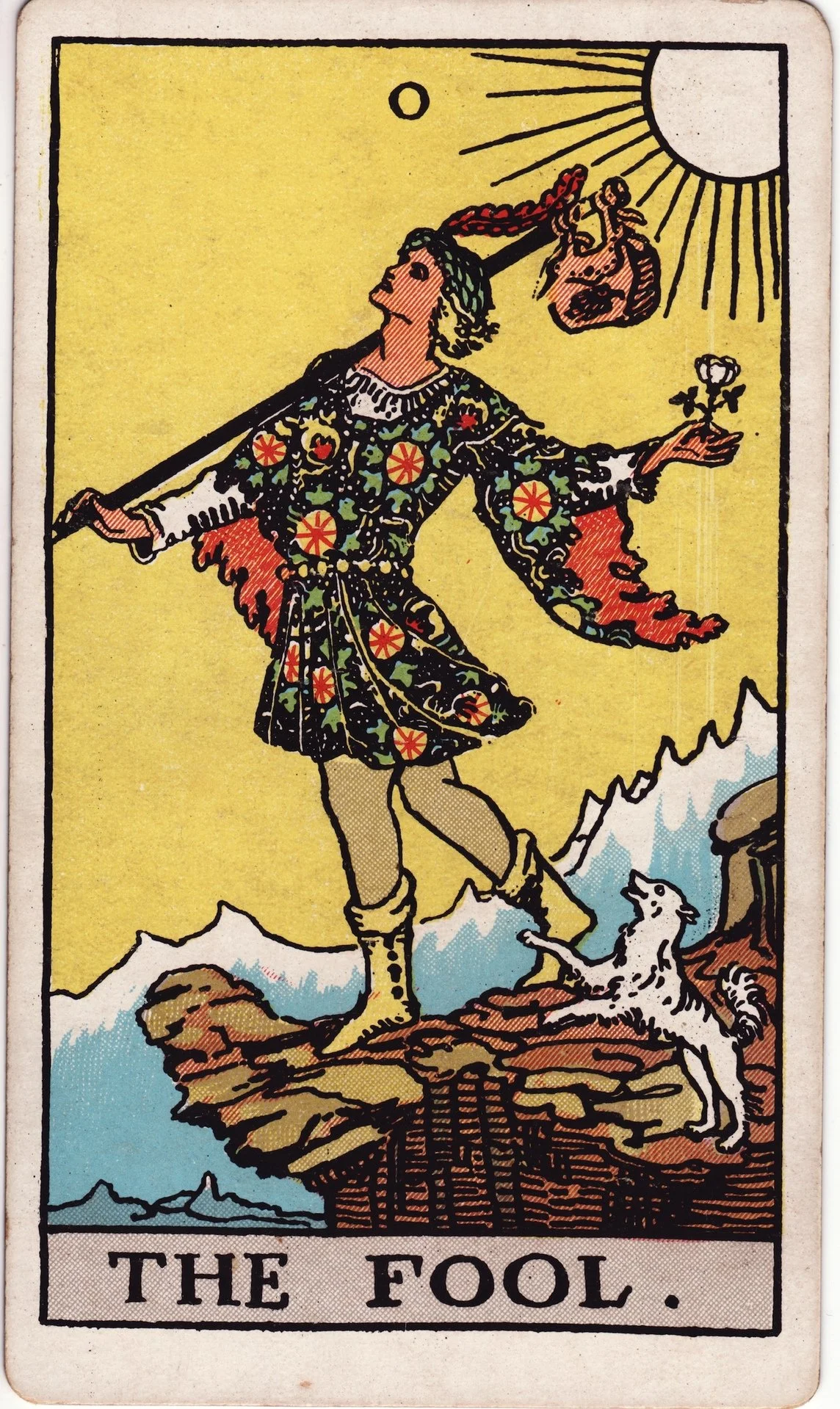
Pamela Colman Smith, 1909, The Fool card holding a white rose.
Would it surprise you, though, to learn that this most common of meanings for rose is related to neither the Fool nor the Magician card? Not beyond that, the white rose the Fool holds represents that innocent, pure, blank canvas suggestion of the roses stained red with Aphrodite's blood. The Fool holds a white rose to let us know this is the beginning, the fresh, the existence prior to the change. And in many cultures, white flowers are customary funeral flowers, associating them with death, too. In fact, we see the white rose reemerge on the flag thirteen cards later with Death. Death being the ending that brings about rebirth, a new beginning. The Fool is that new beginning.
But as for the red roses, they mean romance, right?
Not always. And in the case of the Magician card, those rich red blooms signify mysteries far more interesting.
According to The Book of Symbols: Reflections on Archetypal Images, Eros, the god of love and Aphrodite’s son, bestowed Harpocrates — the god of silence — a red rose in gratitude for maintaining his discretion about some of the goddess's “illicit amours.” This story is said to be the basis for the term sub rosa and the practice of roses hanging from and later designed into the ceilings of rooms where private meetings were held.
What happens sub rosa has remained sub rosa long before Las Vegas thought of its catchy advertising slogan.
Roman politicians met sub rosa when they wanted to keep what was said private. Alchemists conducted their work sub rosa, as they were working to solve certain mysteries and wanted their findings kept secret.
No wonder the Magician — who bears other symbols of alchemy and stands in the pose directing the energy of that which is above to be in existence below — is performing his magic sub rosa.
Waite doesn't give the roses above the Magician much attention, though. Perhaps because that meaning would've been recognizable to Europeans even in the early 20th century, who still held a deep connection to their historical Roman roots. Instead, he writes about the flowers beneath the Magician, citing “flos campi and lilium convallium” a reference to the Song of Solomon of the Old Testament. The full line ego flos campi et lilium convallium roughly translates into English as, “I am the flower of the field and the lily of the valleys.” However, the line as translated into the King James Version of the Bible is, “I am the rose of Sharon, and the lily of the valley.” And again, those same ties to their long history, the biblical reference would've been like us understanding pop culture references in movies we watch today.
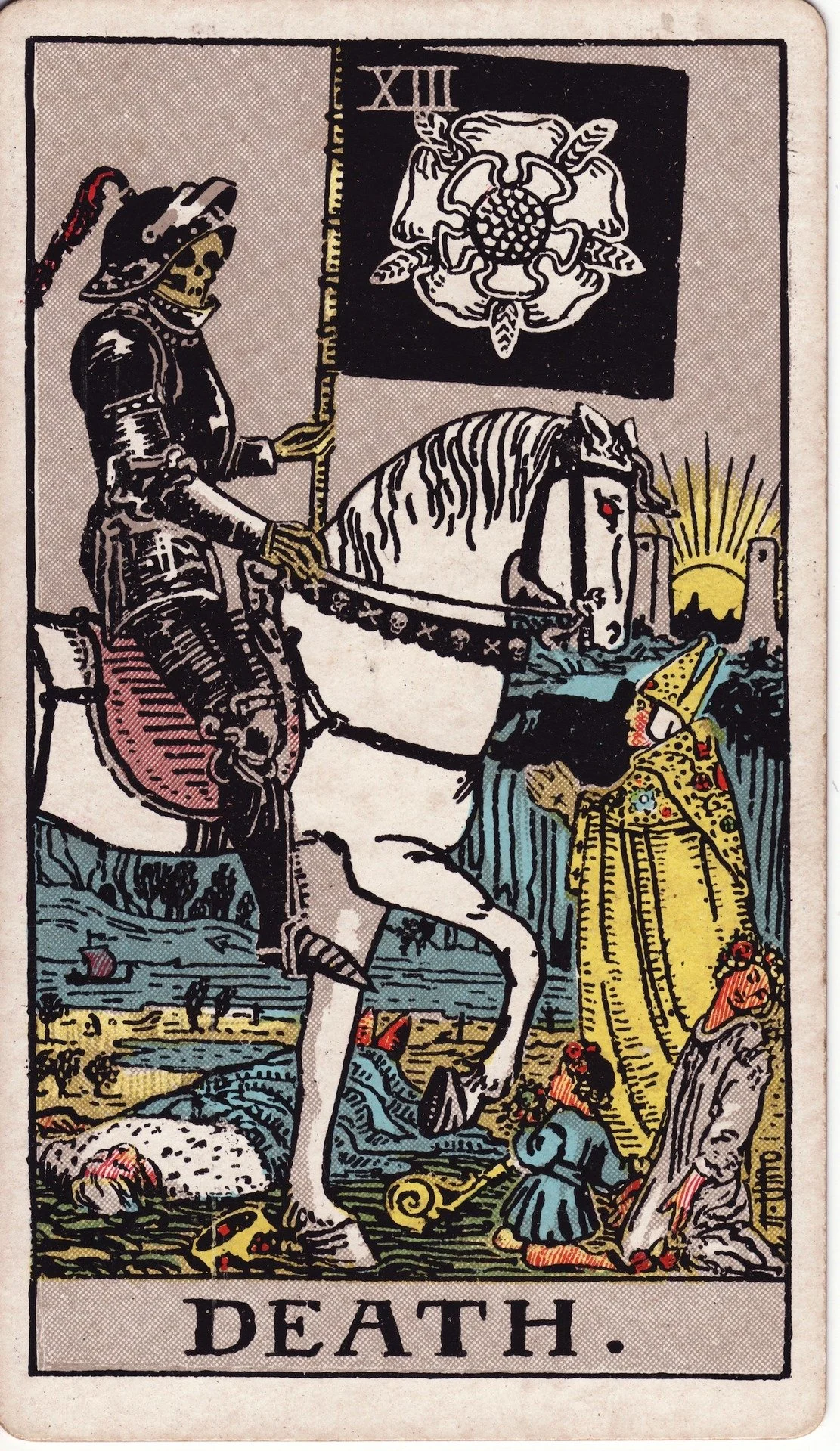
Pamela Colman Smith, 1909, the Death tarot card showing a white rose on the flag.
However, in 21st-century America, would you be surprised to learn that this verse is an indirect way of saying Jesus and Mary — or at least their spirits, and even deeper, the mysteries of their existence — are present in the Magician card? Or that the poem suggests Mary and Jesus were spiritually wed to each other?
What the…? You may be thinking. How does an old testament bible verse about flowers (roses) and lilies have anything to do with Jesus and Mary, and how are those two related to the Magician? And why would they be married to each other, even metaphorically?
It was a goal of Waite’s and executed by Smith to include more recognizable Christian symbolism into their deck to make it easier for their contemporaries to understand the visual language. In particular for this discussion, it is important to note that Waite references the Instituted Mysteries and Secret Tradition, gnosis and Gnosticism, and many other secretive and mysterious esoteric and occult entities throughout his Pictorial Key. And let’s not forget, Waite and Smith were members of the Hermetic Order of the Golden Dawn.
A secret society dedicated to deciphering the secrets of the occult.
A secret society founded by members of the Freemasons and the Rosicrucians. The Rosicrucians, whose emblem was a cross with a rose on it, whose teachings and beliefs are a blend of occultism, Jewish mysticism, and Christian Gnosticism. You know, people interested in investigating and understanding the mysteries of divinity and the supernatural.
All secret societies that tie back in some way or another to the Knights Templar. (And Waite was obsessed with Holy Grail lore - in fact, the emblems of the four suits on the table in front of the Magician are a double nod to the quest for the grail).
Many of the greatest mysteries of Christianity lie with the life of Jesus and the immaculate conception of Mary.
The Magician stands beneath the roses, sub rosa. The Magician is on the inside. They know the secrets to the mysteries.
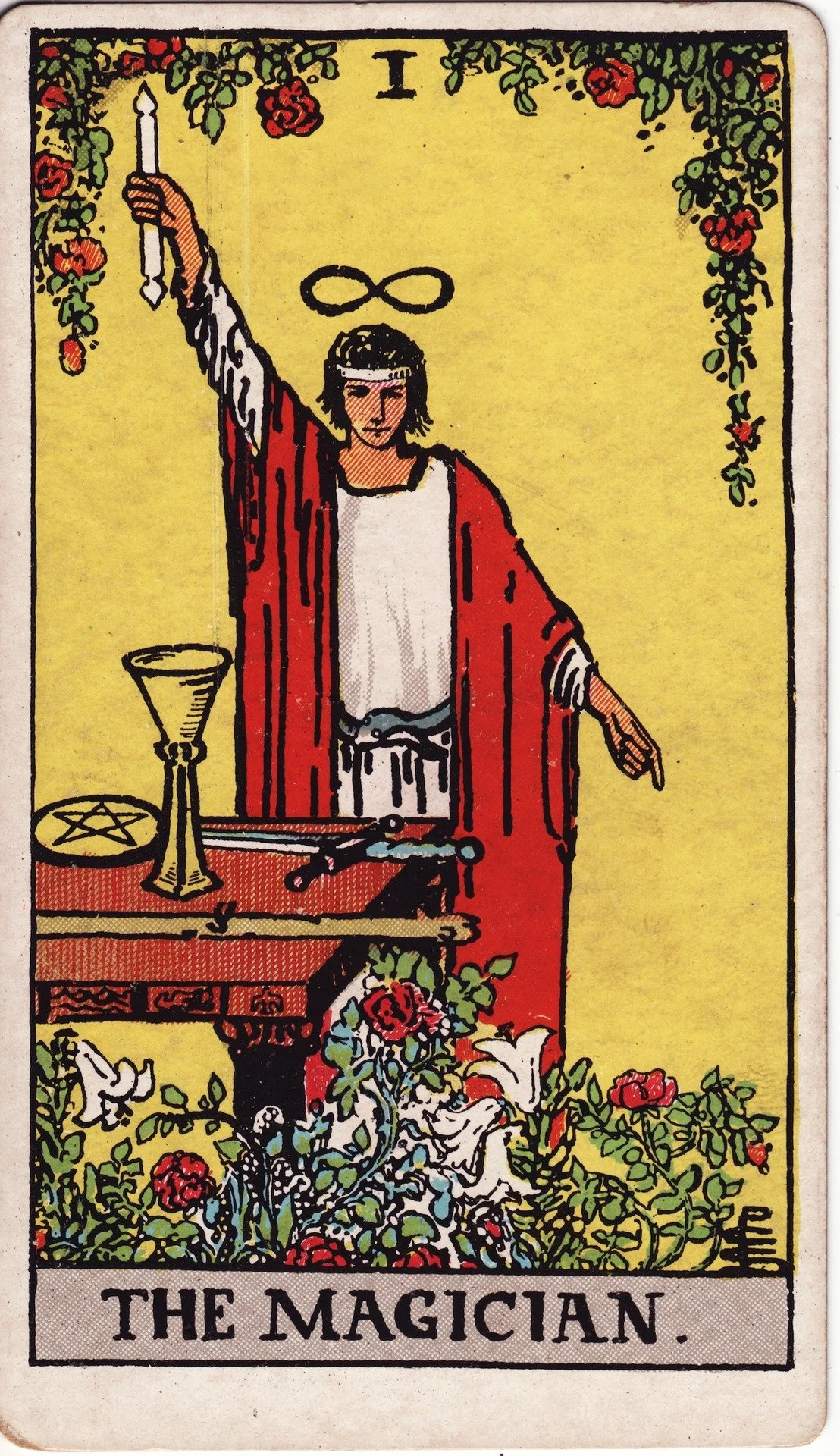
Pamela Colman Smith, 1909, the Magician tarot card surrounded by red roses and white lilies.
But again, Waite doesn’t really touch on the sub rosa theme. Even in his wording in his Pictorial Key to the Tarot, he writes, “Beneath are roses and lilies…”
He may have been focused on the presence of mystery in the life of Jesus. Jesus is both man and divine. His mother conceived him divinely and became the vessel that literally manifested divinity on earth. It’s a blind truth Catholics have accepted since it was decided so at the Council of Nicea in 325 CE, but it’s a real head scratcher the second you try to break down how that works.
Okay, you may say, and what does all of that have to do with the Song of Solomon, an erotic poem from the Old Testament?
Well, I’ll tell you.
At the rise of Christianity in Western Europe, literacy was on the decline. The Visigoths, Ostrogoths, and other Northern tribes were moving in, and the remnants of the Roman Empire as we think of it were crumbling. The Goths and the Franks who were moving their way down didn't speak Latin. All in all, it's a long story, a long history, and if you’re curious to know why and how it happened, I can’t recommend researching it enough. Medieval history is fascinating, and if you’re interested in the tarot, there’s more of a connection than many contemporary readers may realize. But I digress.
When literacy was revived, and the lost writings of pre-Christian philosophers and historians were discovered, the Catholic church had a little bit of an existential crisis.
A big thank you to all the Arabic scholars who rescued literacy for the West, by the way!
Anyway, the writings of Plato and Aristotle made their way to the surface again, and to medieval academics, they made a lot of sense. In fact, they shared much of the same philosophy as medieval Christians, but how could that be? These pagans worshiped all the wrong gods. They were all going to hell, certainly.
(Dante helps with that whole conundrum by inventing the modern idea of Limbo, by the way, in his Inferno.)
I am way oversimplifying this, too. But to fit a story spanning about 1500 years into this blog post about rose symbolism, the important thing to know about the tarot is that medieval theologians spent hundreds of years reconciling pre-Jesus writings and teachings to somehow be prophetic of Jesus.
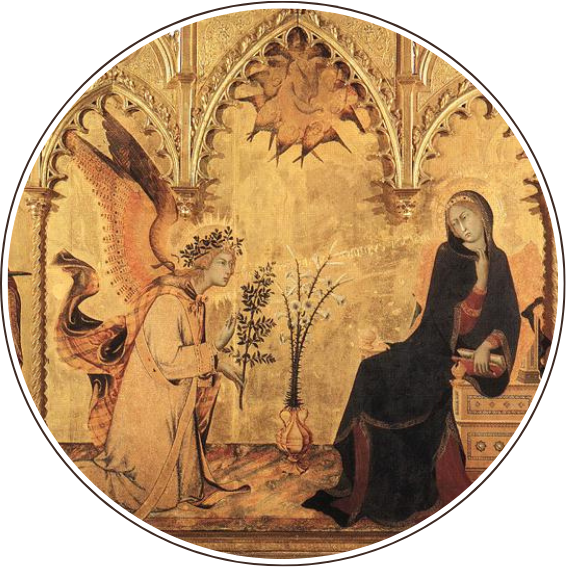
Simone Martini, 1333, Annunciation.
And an ancient love poem in the Old Testament, one that was super spicy and erotic, definitely needed to be given an explanation as to why it was in the holiest of books. Especially since good old Saint Augustine had his crisis of conscience over his own youthful promiscuity back in the late 4th century CE and wrote the doctrine on how sex was super sinful. Leading to the millennia of repression in that faith, but again, I digress.
And those medieval theologians were good at what they did. They found a way to make that a metaphorical piece prophesying the coming of Jesus and his sacred union with his mother, as both her son of immaculate conception in life and she as his bride in spirit, as they together combine to embody the Holy Spirit of the Church.
The fact that this was a semi-incestuous relationship is explained away as metaphorical, and it is a spiritual union, not a physical one.
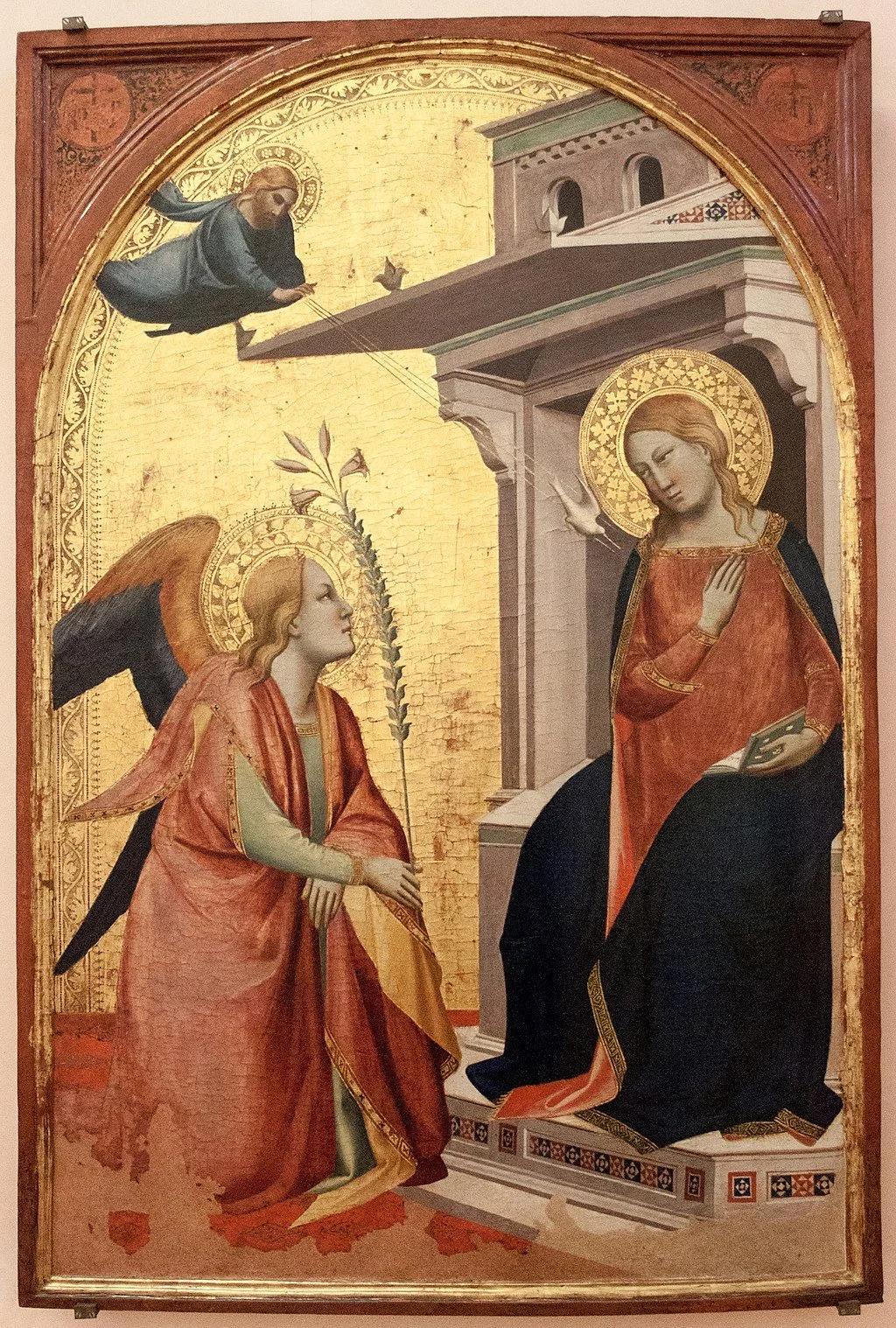
Taddeo Gaddi, 1340-45, Annunciation.
The reference to the rose and lily of the valley from the poem was reassigned to attribute Jesus to the rose and Mary to the lily of the valley. Red roses are associated with Christ due to the blood he sacrificed, being crowned with thorns, crucified, and then lanced while hanging on the cross.
The white blooms in the lily of the valley are associated with Mary due to white being the color of purity. Another interpretation is that the flowers symbolize Mary’s tears as she watched her son be crucified. Both the lily of the valley and other varieties of the white lily became signifiers of Mary, especially in medieval artworks showing the Annunciation, where the flowers are often in a vase between the angel Gabriel and the Virgin.
If I’ve lost you a little bit, I apologize. It is deeply philosophical and a topic usually taught over the course of a semester or two. What I want to illustrate is that the presence of red roses and white lilies, along with the Song of Solomon quote, very much indicates a reference to Mary and Jesus. Which in the context of a card about manifestation and mysteries, makes sense with Mary being that vessel who brought the divine to life on earth as man by way of her immaculate conception. And that is one of the greatest mysteries of the Christian faith, accepted by the masses on blind faith alone.
It’s also important to note that during the later Middle Ages, Mary’s status was elevated from Mother of Christ to Queen of Heaven. In this way, she becomes another great mother goddess, or the great goddess, or another avatar of the goddess of wisdom — Sophia. I examine this further in the next post about the High Priestess.
And the Magician, they are in tune with all of that. They too are the vessel that takes the divine mysteries and manifests them here on earth.
Bibliography
“First Council of Nicaea.” Visit the main page. Accessed January 31, 2024. https://www.newworldencyclopedia.org/entry/First_Council_of_Nicaea.
Giesecke, Annette. The mythology of plants: Botanical lore from Ancient Greece and Rome. Los Angeles, CA: J. Paul Getty Museum, 2014.
“Hermetic Order of the Golden Dawn.” Visit the main page. Accessed February 26, 2024. https://www.newworldencyclopedia.org/entry/Hermetic_Order_of_the_Golden_Dawn.
Jack, Father Rob. “Bride in Song of Songs as a Type of Mary.” Bride in Song of Songs as a Type of Mary : University of Dayton, Ohio, January 17, 2024. https://udayton.edu/imri/mary/b/bride-in-song-of-songs-as-a-type-of-mary.php.
Janega, Eleanor, and Neil Max Emmanuel. The Middle Ages: A graphic history. London: Icon Books, 2021. -
Kaplan, Stuart R., Mary Katherine Greer, Elizabeth Foley O’Connor, and Melinda Boyd Parsons. Pamela Colman Smith: The untold story. Stamford , CT: U.S. Games Systems, Inc., 2018.
Matthews, Caitlin. Sophia, goddess of wisdom, bride of god. Wheaton, il: Quest Books, Theosophical Pub. House, 2001.
Nozedar, Adele. The element encyclopedia of secret signs and symbols: The ultimate A-Z guide from Alchemy to the zodiac. London, UK: HarperElement, 2008.
“Rosicrucian.” Encyclopædia Britannica, January 19, 2024. https://www.britannica.com/topic/Rosicrucians.
Symbolism, (ARAS), Archive for Research in Archetypal. The book of symbols. reflections on archetypal images. Köln: TASCHEN, 2022.
Waite, A.E. The Pictorial Key to the Tarot: Pamela Colman Smith commemorative set by Stuart Kaplan. stamford, CT: U S Games Systems, 2009.
Image Credits
Annunciation with St. Margaret and St. Ansanus. (2023, June 19). In Wikipedia. https://en.wikipedia.org/wiki/Annunciation_with_St._Margaret_and_St._Ansanus
Death (tarot card). (2023, November 6). In Wikipedia. https://en.wikipedia.org/wiki/Death_(tarot_card)
“Floral Poetry and the Language of Flowers : S., J. H : Free Download, Borrow, and Streaming : Internet Archive.” 2014. Internet Archive. 2014. https://archive.org/details/cu31924068941578/page/n9/mode/2up.
The Magician (tarot card). (2023, December 23). In Wikipedia. https://en.wikipedia.org/wiki/The_Magician_(tarot_card)
Taddeo Gaddi. (2024, January 14). In Wikipedia. https://en.wikipedia.org/wiki/Taddeo_Gaddi
