
Tarot FAQ’s from My Table
Over the years, a few questions have come up often enough to become my personal Tarot FAQs. These are not the same as the information I provide for getting a reading, so if those are questions you have, please check out my Tarot page for answers to more generalized questions. These are the most frequently asked by people who usually get a reading from me at a public market, and they range from general curiosity to people who may be interested in learning to read for themselves. So in case you’ve ever wondered…
What is the difference between Tarot and Oracle decks?
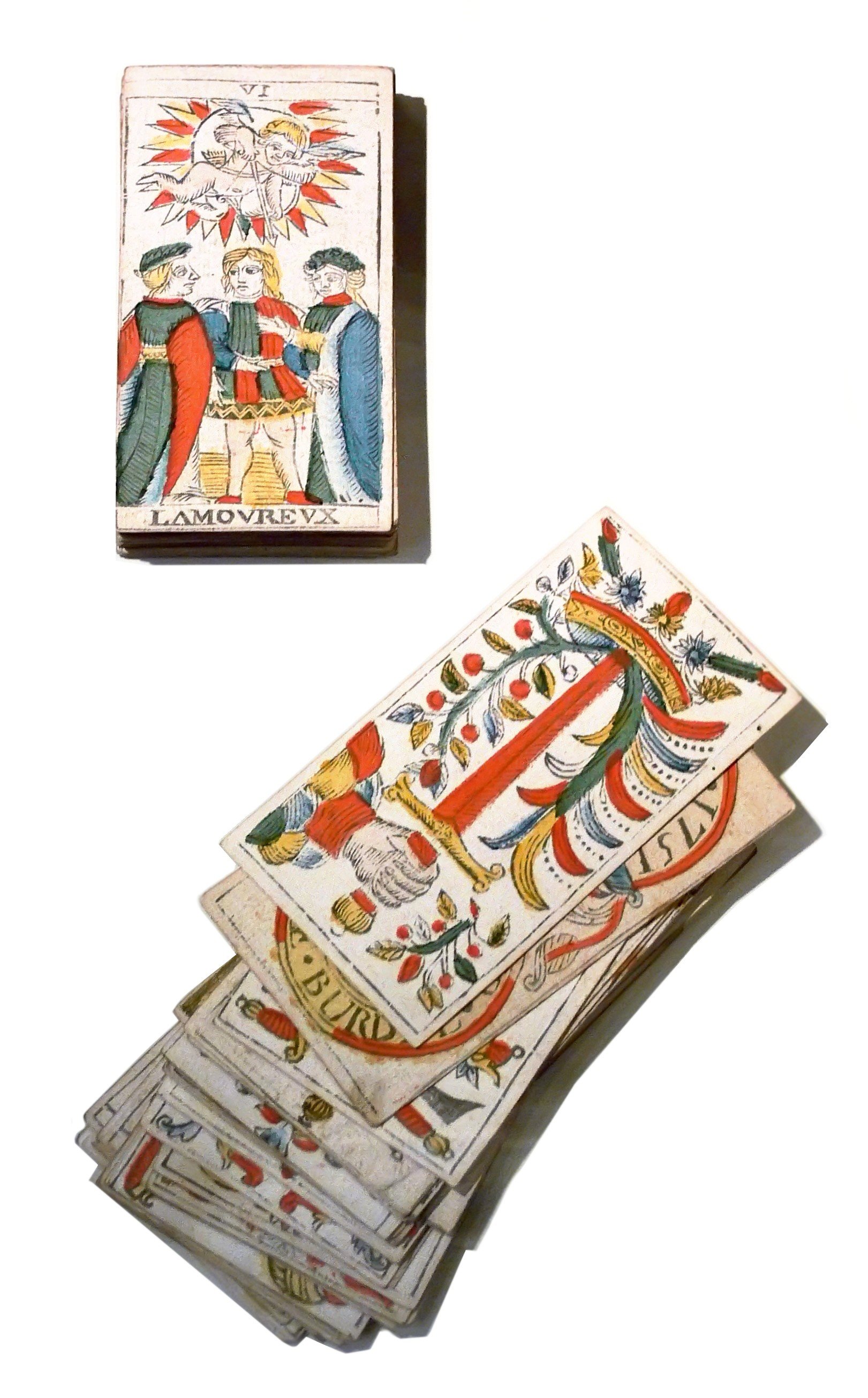
Tarot de Marseille deck from 1751, Ravensburg, Museum Humpisquartier. Photo by Andreas Praefcke via the Public Domain.
This may be the number 1 question I’m asked by friends, family, and people who sit down at my table when I’ve done readings. It’s rather simple. But of course, I will answer it in my overly pedantic way…
Tarot decks follow a 78-card formula, sometimes 79 if a blank card is included. Most decks are derived from two traditional decks: the Tarot de Marseille or the Smith-Waite deck (also known as Rider-Smith-Waite, and sometimes shortened to the RWS).
The Tarot de Marseille predates Pamela Colman Smith and Arthur Edward Waite’s 1909 collaboration and, unlike Smith’s deck, does not have pictorial scenes on the Minor Arcana cards. Instead, the Two of Cups shows just that—two cups. The meanings were more mysterious, as one had to know esoteric symbolism, numerology, and other occult knowledge to interpret these direct cards.
In 1909, Arthur Waite commissioned Pamela Colman Smith to illustrate a deck based on his interpretations. Waite aimed to make the deck more accessible to the lay reader while adding symbolism that reflected his interests. Smith is said to have completed these illustrations within months, and she revolutionized the tarot by introducing pictorial representations to all 78 cards.
Her artistic style was also influenced by Japonisme, giving the cards their flat, bold colors and outline style. I believe this is why they remain timeless despite the heavy influence of Medieval scenes and settings.
In tarot communities, I’ve heard readers of the Tarot de Marseille described as followers of the ‘French School of Tarot,’ and Pamela Colman Smith and Arthur Edward Waite credited with creating the ‘English School,’ or sometimes the ‘Anglo-American School.’
The biggest difference between Tarot de Marseille influence and Pamela Colman Smith is this:
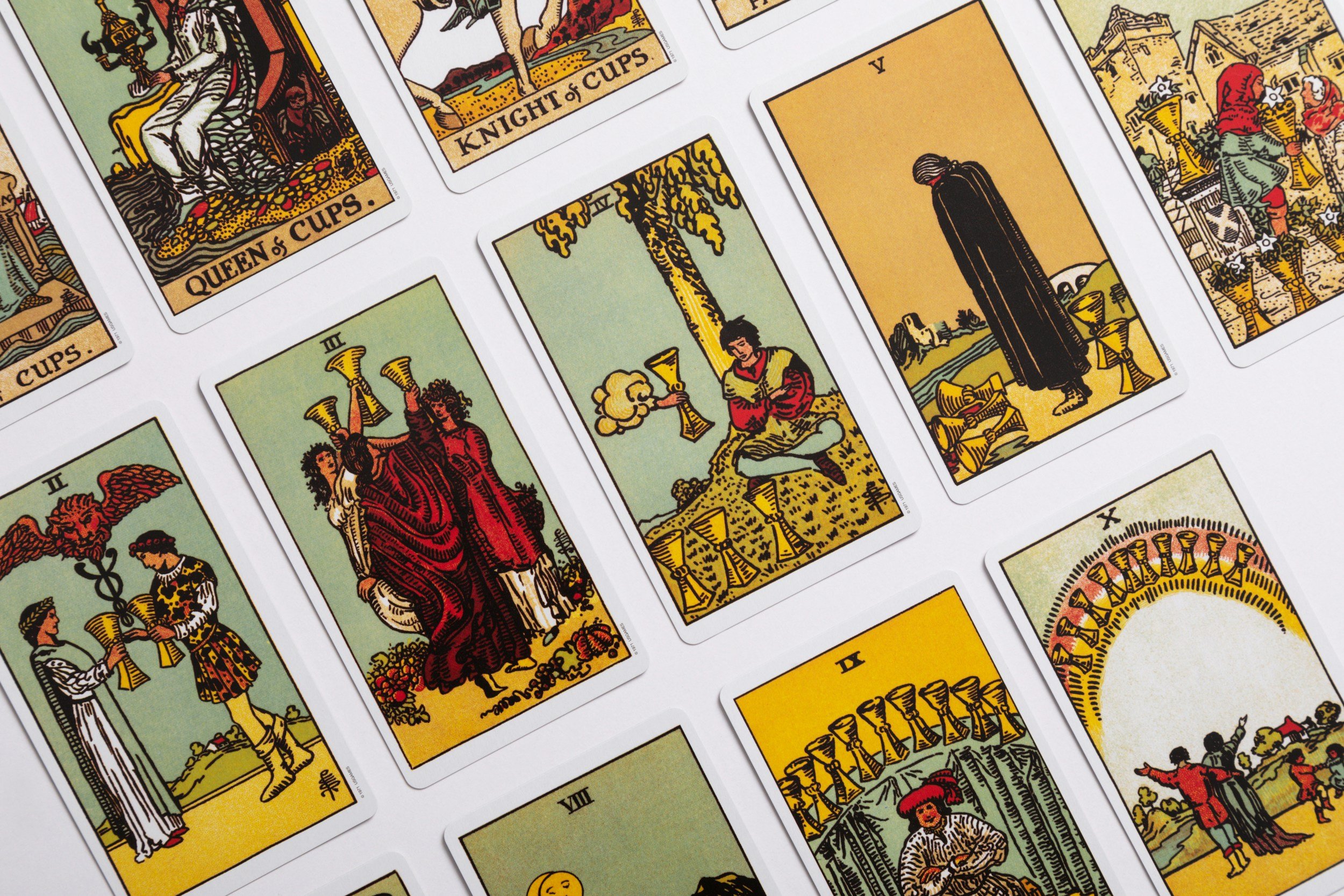
Examples of the suit of Cups in the Pamela Colman Smith deck (1909).
a) Do the Minor Arcana cards show pictures with settings and people involved, or are they primarily numbers of objects, with people showing up only in the court cards?
If it’s the first, your deck is likely inspired by the Smith-Waite tradition. The other would be a Marseille-influenced creation, no matter how decorative the pip cards are.
In some of the Marseille-influenced decks, there is the presence of a white or blank card, meaning they sometimes number 79 rather than 78.
I’ve also purchased several Smith-Waite descendants where the creator(s) added cards to the Major Arcana, so it’s less about the number of the cards and more about whether they follow the formula of 5 suits—Major Arcana and 4 Minor Arcana suits.
If so, that is a tarot deck.
Oracle decks are open-ended. Creators can choose any theme they want and any number of cards they want. I have Oracle decks with only 32 cards and others with 85. Some, like the Citadel deck by Fen Inkwright, are broken up into suits, showing a tarot influence, but are still an oracle deck. Same with my Yggdrasil deck gifted to me by my sister. It has suits that follow the 9 worlds of Norse mythology, not the major and minor arcana, which is what makes it an oracle deck (though the creators call them Norse Divination Cards, which I think is fun).
So, while The Forager’s Daughter Tarot & Guidebook uses a flora and fauna theme, it follows the formula of the Major Arcana and the four suits. Same with one of my favorite decks to use, Journey to Oz & Wonderland Tarot Deck, which gives each card a scene or character from the Alice books or the Oz books while still following the tarot formula.
Matt Hughes created the popular Ethereal Visions Illuminated Tarot Deck and its Luna edition, which restyled the classic Smith deck with Art Nouveau-influenced illustrations and added a couple of Major Arcana cards. He also has many oracle decks, including the Dreamscape Oracle and his “Book Decks,” two of which I own and love: Lady Stirling's Wicked Garden Oracle and Mother Mort's Carnival of Souls Oracle.
So to recap, if it follows that 78ish-card, 5-suit formula—it’s tarot. If it’s open-ended, it’s likely an oracle deck.
Do I have to ask a question?
I don’t like to say anything is required in a tarot reading. I have sat with many readers who have an entire ritual to open and close their readings, and I suppose I have them too. Mine are just bare bones.
I’ve taken several classes from well-known tarot readers, authors of some of the contemporary canon tarot texts, and deck creators themselves. They say yes. I have pages of notes about how to guide the people sitting at my table to find their question.
But when you’re sitting down to a tarot reading because you’re out at a moon market and your only reason was, “why not?” or, “I’ve never had one before, I thought I’d check it out,” we don’t have a lot of time to drill down into your soul’s deepest desire and keep to a 20-minute time limit.
Without a question, though, there won’t be a lot of meaning.
So, I say yes, it’s best to ask, at least, the basest of questions. And when people sit down only because they’re curious, or they want to try something new and don’t have a burning question in their mind, I ask the cards, “What does [name] need to know today?”
Sometimes I want to read for myself at home simply because I want to connect to my cards, and that is often the question I ask for myself. The answer is usually some variant of the same, because I am who I am. I struggle with the challenges of being who I am in the world, so it’s usually more of the same, even if different cards show up to deliver the rerun for the overall message. Then, when I have something specific to ask, I find the answers have much more depth and detail related to the question I asked.
So long story short (too late again?), yes, even if the question is general, your reading will be better if you ask a question. And the more explicit you are in what you’re asking, the more detailed the answers will be.
Can I ask ‘yes’ or ‘no’ questions?
Yes. Some may tell you no, and when I first started, I felt the same way. If someone had a ‘yes’ or ‘no’ question, I would pull out my pendulum.
I have come across readers who ascribe a ‘yes’ or ‘no’ meaning to each card and might pull a single card to answer these questions. That doesn’t quite work for me, but it is definitely one way to do it!
I took a class (well, it was a recording of a live class that I paid to access) with Mary Greer through Global Spiritual Studies, and in her class resources she gave us a copy of a Yes-No spread she’d found in a magazine back in the 1970s. This is what I use, and I’ve adapted it quite a bit over the years because the instructions were extremely basic. If the card lands in either of the top-left spots = yes; top-right two spots = soon; bottom-left two spots = delay; bottom-right two spots = no. That was it.
Over the years of reading with this, though, I found that no matter the answer, the spread as a whole gives so much more information than a simple yes or no. I would often dread it when someone came to my table with a yes-or-no question because, at the time, it meant helping them reshape it into a “What is the guidance for…” type of question. And I always felt like I hadn’t given that person the answer they truly wanted. Now, I love when people ask a yes-no question because I find this spread to be one of the most straightforward to use, and even when people get a ‘no,’ there’s usually a message in there as to why or guidance on how to change it from that ‘no’ to a ‘yes.’
How do you know which spread to use?
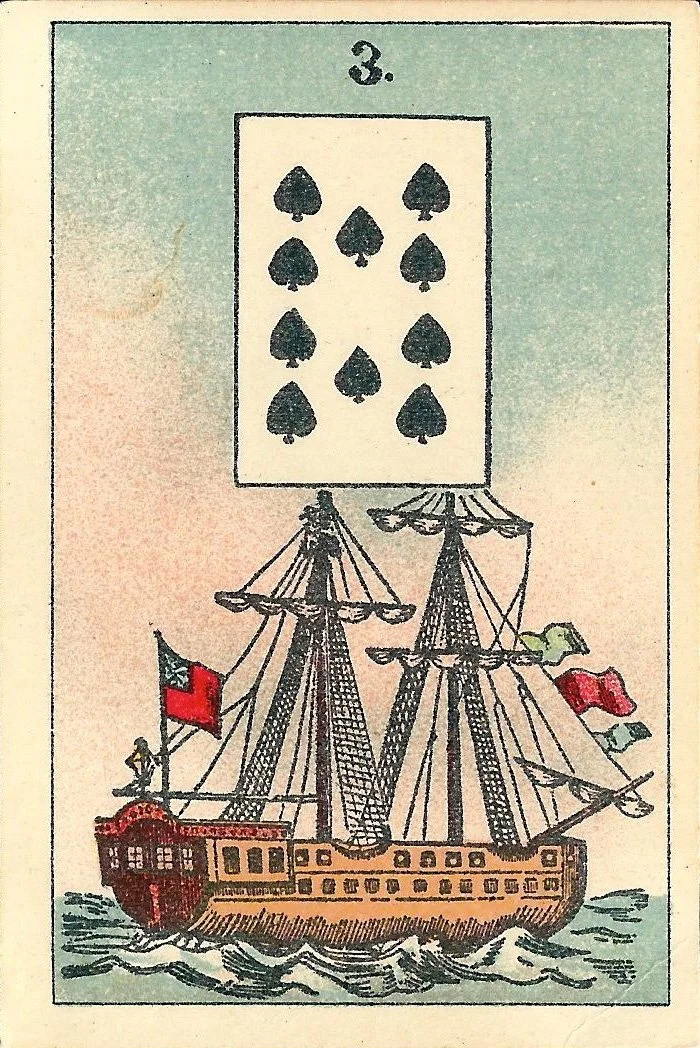
A Lenormand card from Germany, published circa 1890, based on a deck from 1854 via the Public Domain.
For me, it depends on the question. Like with the ‘yes’ or ‘no’ questions, I’ll use that specific spread; if someone asks for guidance on a specific situation, I might pull out the ‘Plan’ spread I learned from The Romantic Lenormand by Anna Oginski, published by Lo Scarabeo.
Like tarot, Lenormand follows a formula, usually consisting of 36 cards with everyday symbols rather than more esoteric ones. It's also based on a card game, which is why most versions of the deck incorporate playing card imagery. For instance, as seen here, the third card in a Lenormand deck is ‘Ship,’ and it relates to the 9 of spades.
The thing I love about Lenormand is that its symbolism and interpretations are much more conducive to answering mundane questions, i.e., questions relating to our day-to-day lives like, how should I get my business started? Or should I find a new job?
The ‘plan’ spread Oginski provides in her guidebook works well with any cards, though. It’s a simple 6-card line that addresses the situation (1), the querent in the situation (2), the challenges, obstacles, or the assistance (3), what to do (4), what not to do (5), and the projected outcome. That structure makes it a useful way to end with a clear, practical direction.
If someone sits down at my table and they’re more curious than anything else, I default to the Celtic Cross. I find it to be multi-faceted and nuanced, though I know many card readers who don’t like it. And for all of us out there looking to the cards, the spread that makes sense to you is the one that’s best for you. I started with the Celtic Cross, so it may be that it works for me, because it’s the spread I’ve used the longest and have worked with the most.
I’ve had readings ranging from ones where the reader seems to pull cards with no spread at all to ones who have extremely systematic layouts that include multiple decks, and they’ve all landed.
Do you have a question I didn’t answer here?
I’d love to hear it! Feel free to email me at soul.signs.symbols@gmail.com and I’ll happily answer you and add it here to this post if it feels like it fits.

