
Tarot Symbolism: Duality
“When you connect two distinct points, you form a straight line that connects two entities that in many ways are the same but also complementary. Duality is born; conflict and cooperation are now possible.”
—Anthony Louis, Tarot Beyond the Basics: Gain a Deeper Understanding of the Meanings Behind the Cards, 2014
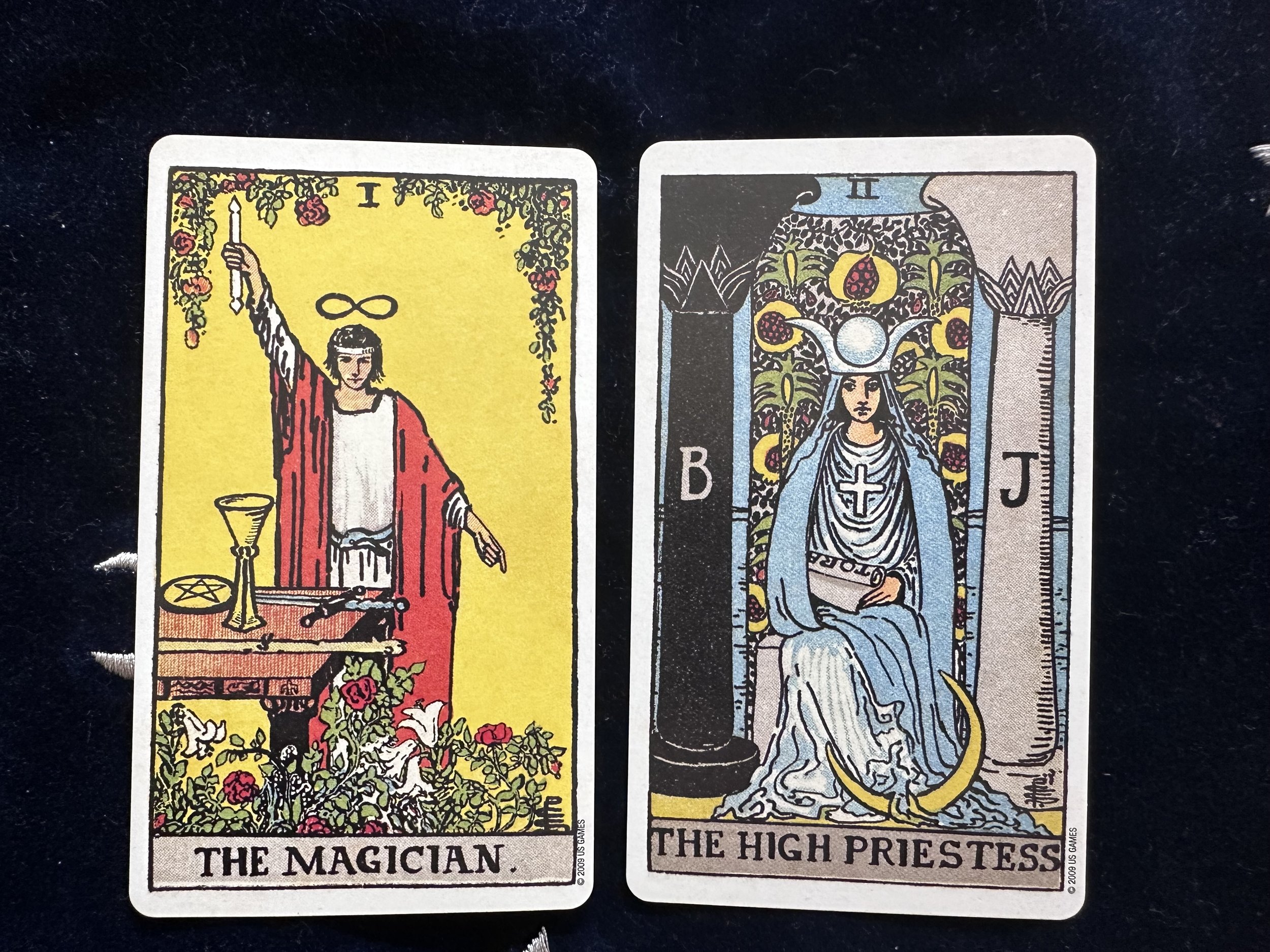
Pamela Colman Smith, 1909, left: the Magician card, right: the High Priestess.
In the Anglo-American tarot tradition, the Fool is the beginning and the end. Therefore, the Fool is also neither the beginning nor the end.
The Magician points one hand skyward, another to the earth, all to illustrate that as above, so is below. The robed figure actively manifests awareness into reality. They are surrounded in earthy colors associated with consciousness, daytime, and masculine energy.
From the Magician, or point 1 in the Major Arcana—the first numbered card—to point 2, the High Priestess, a line is drawn. A connection. Two entities now step from the established beginning (Trump Card 1), and duality is born.
The Magician and the High Priestess are concurrently complementary and opposites. From the masculine yang energy of active manifestation illustrated with vibrant yellow to the cool blues and watery tones of yin energy embodied by the High Priestess. She is divine wisdom personified. She need not act with her wisdom. She is knowing in and of itself.
The High Priestess is the passive divine wisdom of the feminine energy, the darker side to the great goddess, to all life itself. And the Empress brings back that active creation energy again, only this time she is the fertility, the nature, the springtime, the fruitfulness that is nature itself. These two are the two sides of the same goddess, the opposing sides of feminine energy.
The Emperor sits on his throne on the other side of Madam Mother Nature, and he is there to represent the yin side of the same masculine energy as the Magician. He is also the masculine presence to the Empress’s femininity. Duality within the figures alone and the dual natures they represent as they relate to each other.
The Magician and High Priestess, yang and yin. The High Priestess and the Empress, dark mystery and natural creation. The Empress and Emperor, mother and father, soul and mind.
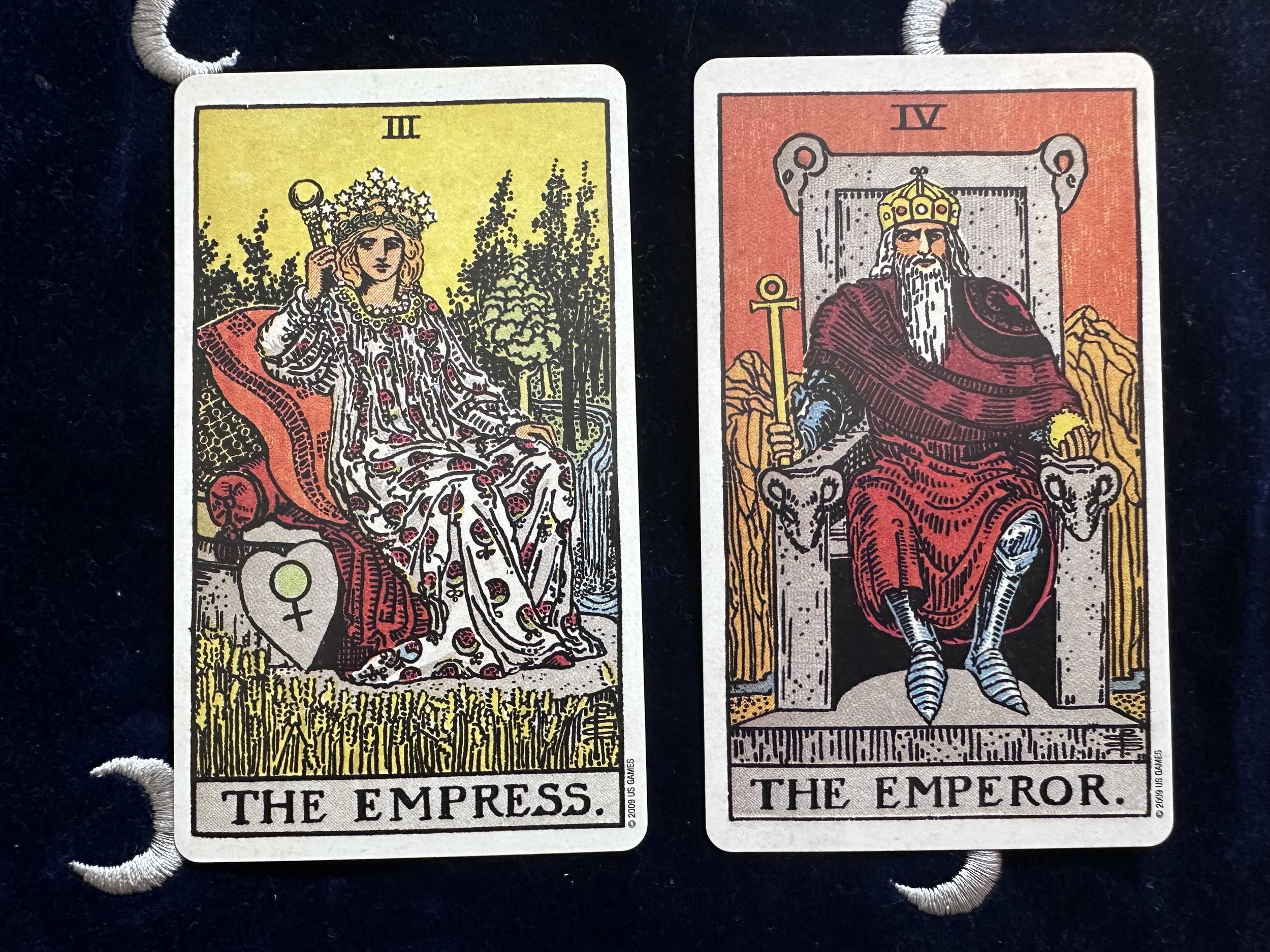
Pamela Colman Smith, 1909, left: the Empress card, right: the Emperor.
Trump number 2—the number of duality, balance, harmony, union, and opposites—introduces duality in a big way. Her mere presence as the second point forms the connection that creates duality.
It all started with the columns behind the High Priestess. Clearly a symbolic representation of dual nature beyond their noted significance as the temple of Solomon and the temple of Isis.
Art history teaches us that pretty much anytime you see two of any shape, figure, animal, etc. that are near but apart and especially if one is light and one is dark, we have a nod at duality. Those columns, at least the ones Pamela Colman Smith created, are pretty significant to telling the reader that the High Priestess represents dual natures, opposing forces, balance, and harmony.
The use of the black letter on a light column and a white letter on the black column may or may not have been directly influenced by the yin-yang symbol we know from Chinese philosophy. By the time Smith was creating her tarot images, Western European artists were well aware of the East (China, Japan, and India). Printmakers in the early 20th century were especially interested in the techniques and styles of Japanese block printing (see any passage of any art history book that discusses Mary Cassatt, a contemporary of Smith’s, and you’ll see what I’m referring to).
Artists and printmakers alike were also enjoying experimenting with the Chinese ink wash painting technique at this time.
Smith—who had a good run at owning and publishing her own literary and artistic magazine, The Green Sheaf—may not have been a printmaker, but she worked closely with them. She created her original tarot images using a combination of gouache—an opaque watercolor paint—and ink. This choice of medium demonstrates the influence of Eastern style and technique on Western art in the early 20th century.
That is a very long-winded way of saying that, while I have no concrete proof to back up this claim, I strongly believe Smith was familiar with the Yin-Yang symbol and that her choice to depict the columns this way was intentional.
The brief, oversimplified meaning for this iconic symbol is that it represents the continuous interconnectedness of both oppositional and complementary forces. It is so potent, so recognizable, so easy to understand, it permeates our modern-day global cultures as one of the most identifiable symbols.
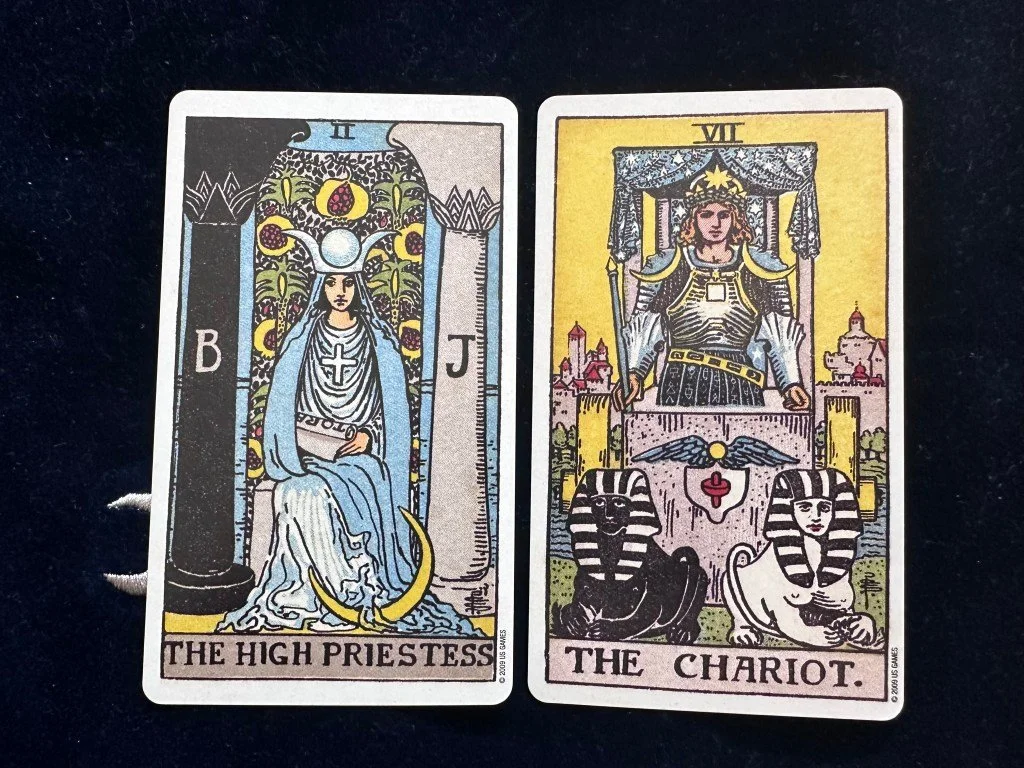
Pamela Colman Smith, 1909, left: the High Priestess tarot card, right: the Chariot.
We see the theme of duality, represented by light and dark, continued in the Chariot with the sphinxes. The High Priestess between the columns sits as the mediator, the in between, both and neither—the embodiment of that liminal existence that encapsulates both, all, and neither. The Chariot, on the other hand, is a person who is now the commander of the discipline it takes to drive forward in possession and full awareness of the dual forces.
Beyond this, we see the theme of duality represented throughout the deck in the following ways:
Relationships
Magician & High Priestess
Empress & Emperor
Page & Knights
Queens & Kings
Opposing Natures
The Lovers
The Devil
The Lovers & The Devil
Union
The Hierophant
The Lovers
The Chariot
Strength
2 of Cups
Balance
The High Priestess
Justice
Judgment
The World
2 of Pentacles
Reconciling of Opposites
Strength
Death
Temperance
The Star
The Moon
Crossroads
The Devil
Judgment
2 of Swords
Awareness of the Other
The Magician
Temperance
The Star
The Moon
Two of Wands
Queen of Cups
We see the columns carry through the major arcana as well in all the cards that also relate to duality:
The High Priestess
The only one who has the light and dark columns and letters.
The High Priestess, Hierophant, and Justice cards all show their central figure sitting on a throne between two columns.
The Hierophant
Columns are Roman, a nod to St. Peter’s Basilica and Roman Catholicism
Crossed keys are a nod to the papacy, the seat of which is in Rome
Columns represent the connection between heaven and earth
The first card we see more than the central figure.
In this way, the two figures at his feet and the base of the columns suggest that the hierophant is bringing about a “papal union” in his card. Bringing together two like figures who may or may not be complementary, and may or may not have a simpatico union. The crossed keys are, in and of themselves, a symbol of union and duality: the key to heaven and the key to the church, God’s house on earth.
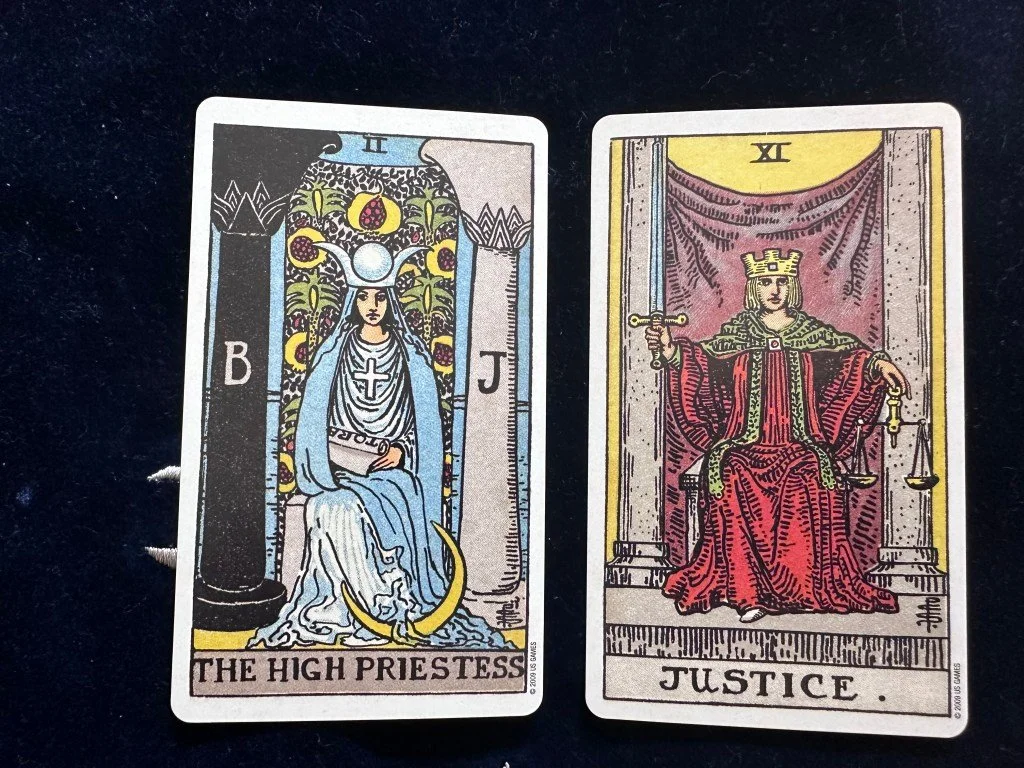
Pamela Colman Smith, 1909, left: the High Priestess tarot card, right: Justice.
Justice sits between two columns as well:
These do not have capitals, but have ornate bases suggesting that she is a figure of earthly matters.
She mirrors the High Priestess in her placement between two columns, with a plain veil hanging behind her and as a robed figure wearing a crown.
She is opposite the High Priestess in that her colors are red and yellow, with no presence of water.
She complements the Hierophant in wearing similar colors.
She complements the Magician in pointing the sword upward in the same hand the Magician points the wand, and the scales point downward, mirroring the as above, so is below message, taking it further that our decisions in life play a role in the creation of our reality.
The Death card shows the next appearance of the columns, now square and outdoors, with the sun peeking up over them.
On the other side of the Tower, the Moon brings up the column in a much clearer view with the sun and moon fully raised between the two.
What was unconscious is now out in the open.
As far as numerology and duality in these cards:
The High Priestess is 2, Justice is 11
11 breaks down to 1+1=2
Look at the two cards side by side and see how similar and different they are in composition and elements
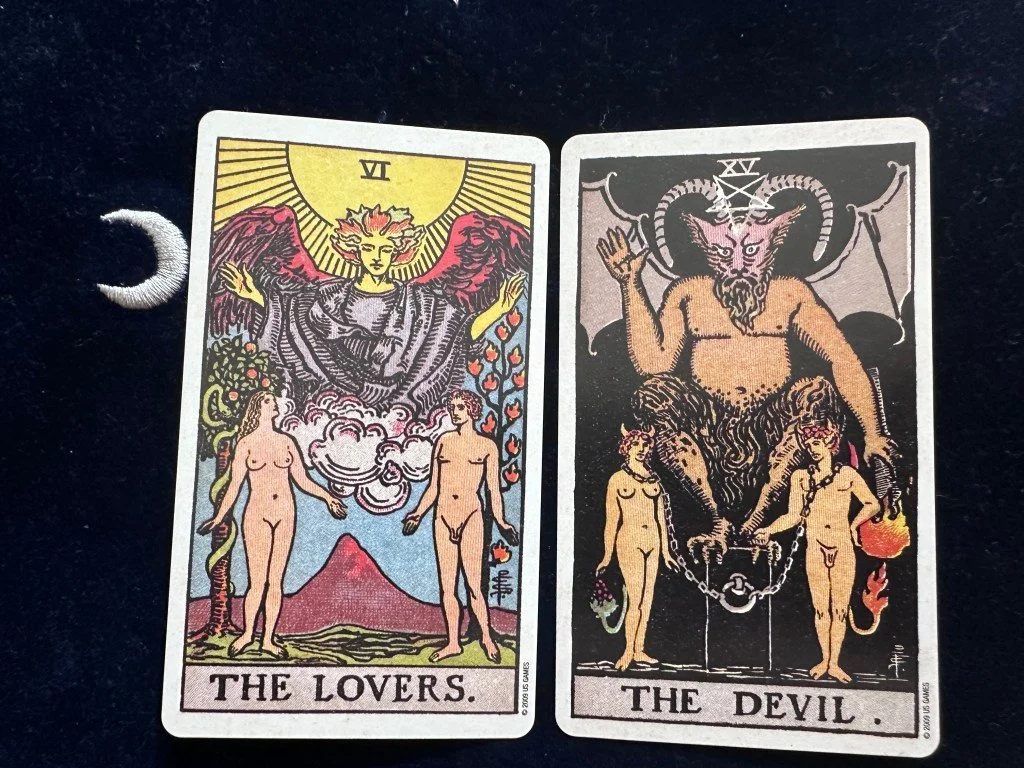
Pamela Colman Smith, 1909, left: the Lovers tarot card, right: the Devil.
The Lovers is 6, The Devil is 15
15 breaks down to 1+5=6
Look at these two cards side by side and see how similar and different they are in composition and elements
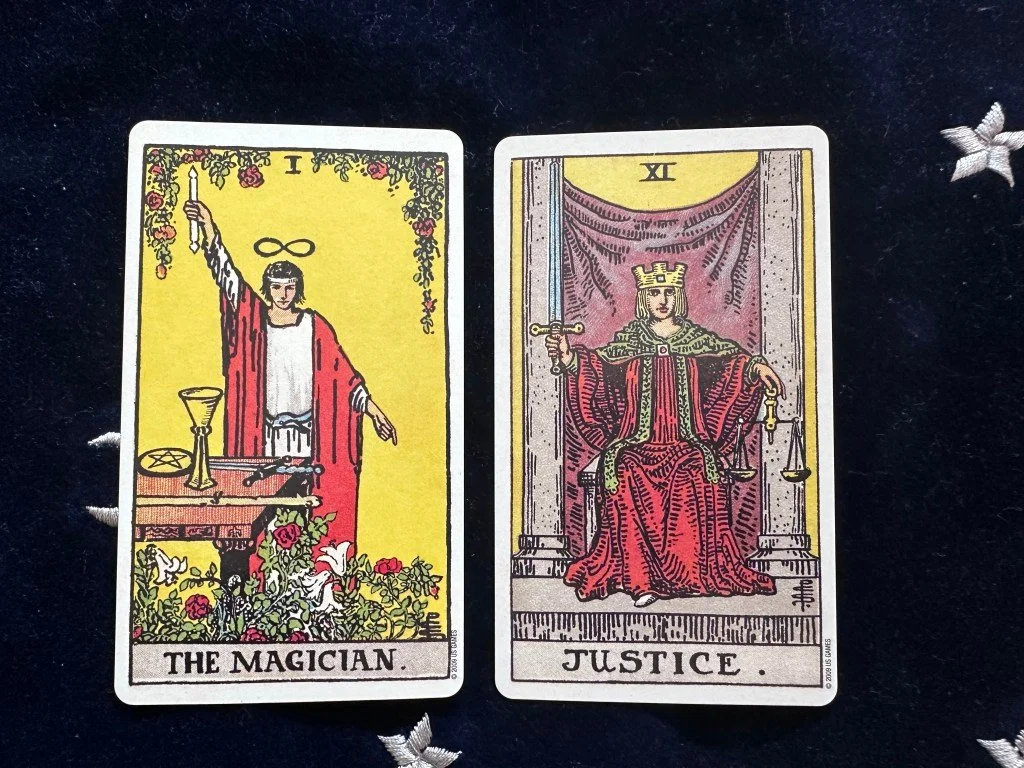
Pamela Colman Smith, 1909, left: the Magician tarot card, right: Justice.
The Magician is 1, Justice is 11
Two 1’s
Look at the two cards side by side and see how similar and different they are in color and their posture
If you've made it this far, I thank you for reading through the blog! If you like what you’ve read, please subscribe to receive my newsletter. Until next time, I hope you feel equipped to begin reading the signs in the cards.
♥️ BB Soto
The deck featured is the Pamela Colman Smith Commemorative Box Set Deck. Photos are by the author.
For further reading, check out my Recommended Reading lists on Bookshop.org.
