
Flowers of the Underworld
How Birth Month Blooms Connect Us to Persephone’s Journey
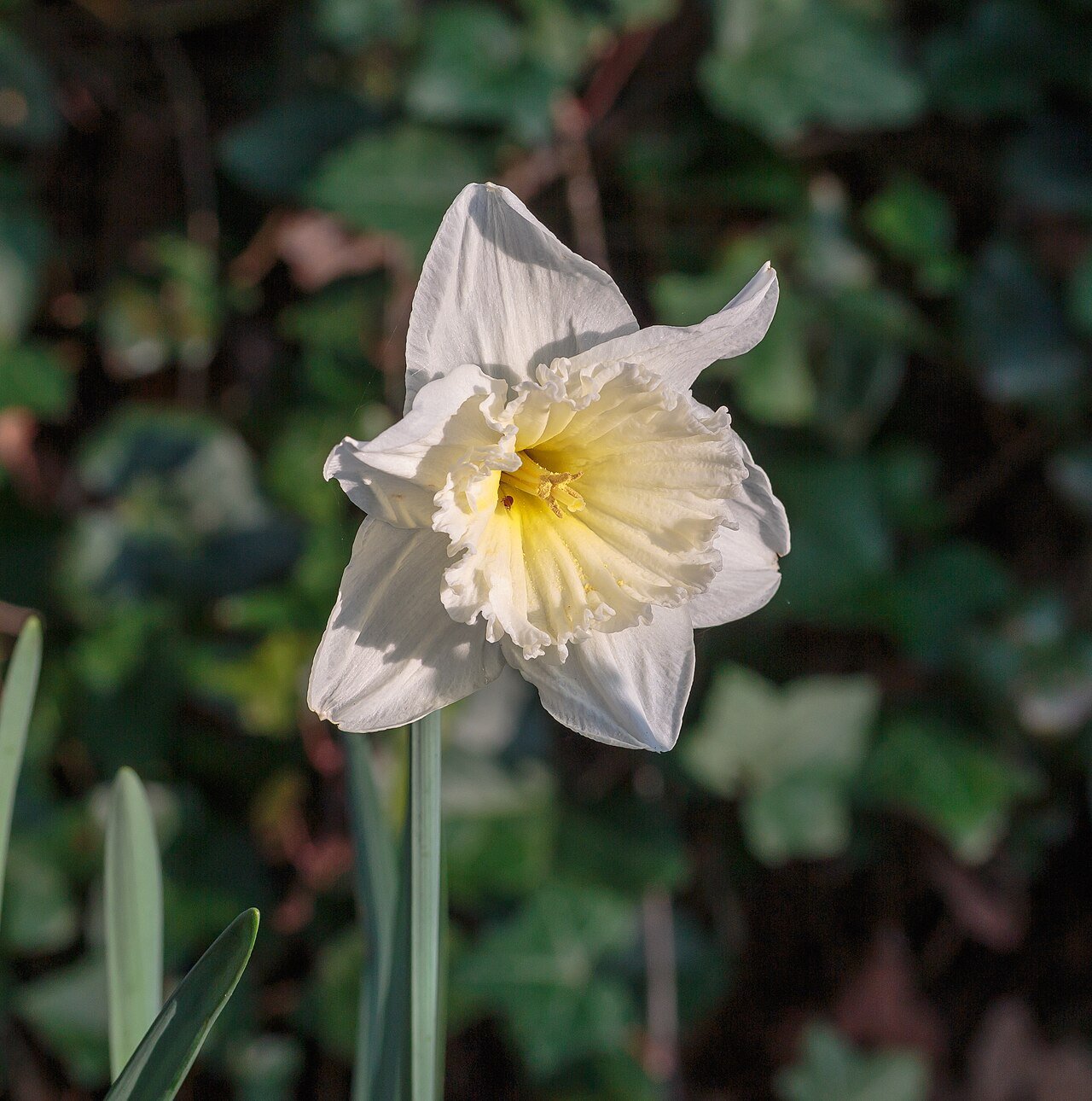
Narcissus bloom by Dominicus Johannes Bergsma - Own work via Wikimedia Commons
In December, when the world descends into its darkest days, Narcissus tazetta aka narcissus paperwhite flowers bloom making them one of the two birth flowers for the month. Holly is the other December flower. These delicate white blossoms with their golden centers hold a profound mythological significance—they are the very flowers Persephone was picking when Hades abducted her into the Underworld. The timing is no coincidence. As December’s birth flower, the narcissus marks the deepest point of winter’s descent, mirroring Persephone’s own journey down into the realm of shadows. She was drawn to their beauty, their fragrance, and in that moment of reaching for them, the earth opened and she was pulled into darkness.
This mythological connection transforms the narcissus from a simple winter bloom into a symbol of threshold moments—those times when we stand between worlds, between seasons, between what was and what will be. Every December, as these flowers bloom despite the cold, they remind us of Persephone’s descent and the necessary darkness that precedes rebirth.
Violets and the Promise of Return
Fast forward to February, and we find violets beginning to emerge—often among the first brave buds to push through lingering snow (for those who live in places where snow happens). Again, their presence in February marks their selection as one of February’s birth flower. In art history, violets have also been long been associated with Persephone in her role of bringing spring back to the earth. Particularly in classical and Renaissance paintings, violets symbolize maidenhood, modesty, and the innocence of spring. They appear in depictions of Persephone before her abduction, representing the purity and promise of youth.
But violets carry a deeper meaning too. Their early appearance signals spring’s inevitable return, just as Persephone herself returns from the Underworld each year. The violet becomes a harbinger of hope, a tangible promise that winter’s darkness will not last forever. Where narcissus marks the descent, violets celebrate the ascent—the reunion of mother and daughter, the warming of the earth, the return of life.
Thanks for reading The Mockingbird Muses! Subscribe for free to receive new posts and support my work.
Ophelia’s Drowning: Another Descent
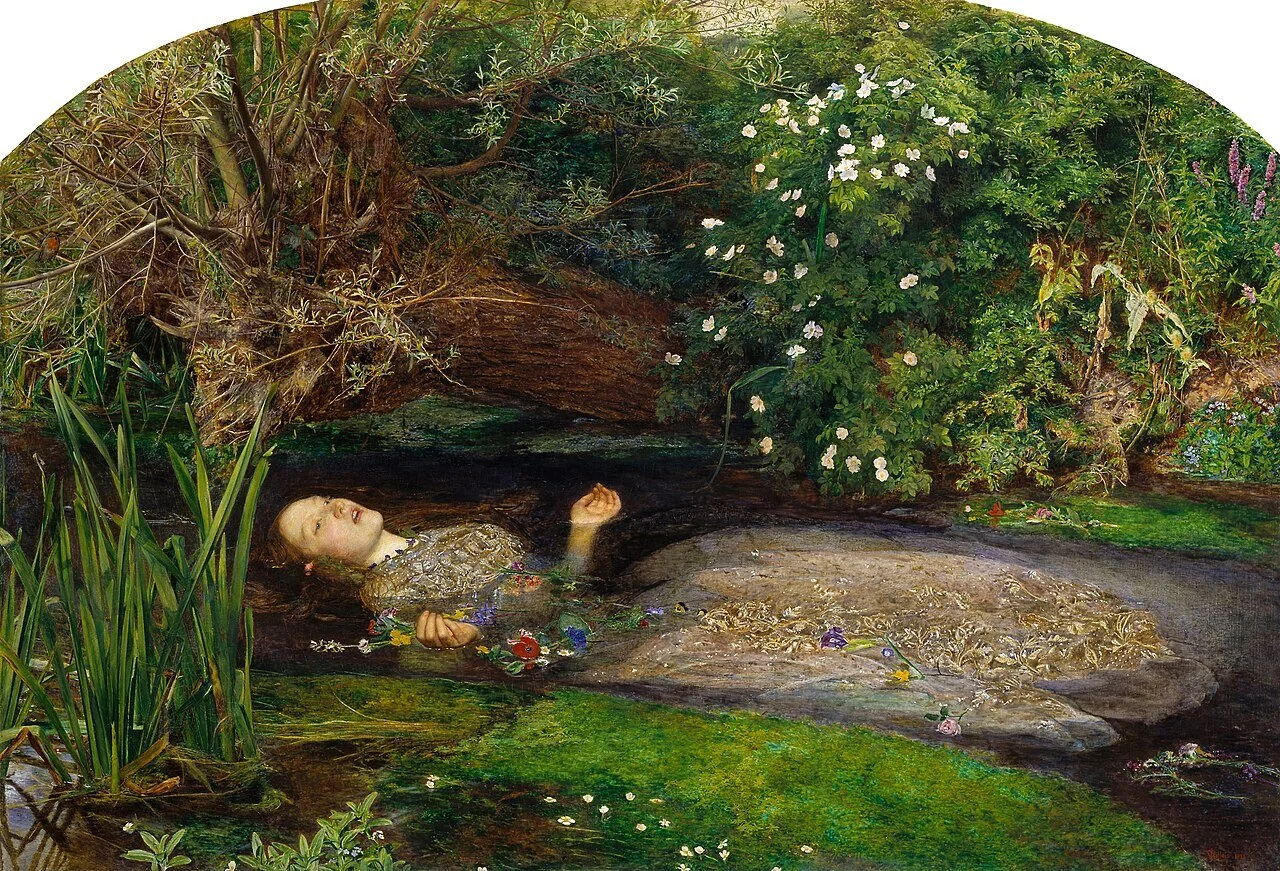
By John Everett Millais; Tate Images via the Public Domain
Persephone’s story finds an unexpected echo in Shakespeare’s Ophelia. Like Persephone, Ophelia descends—but her descent is into literal death via water, that other ancient symbol of the unconscious, the hidden, the underworld of the psyche. When she drowns in the stream, she becomes a mirror of Persephone’s descent. Water, like the earth that opened beneath Persephone, represents a portal to another realm.
The Pre-Raphaelite painters, particularly John Everett Millais in his iconic painting of Ophelia, understood this connection intuitively. They depicted her floating among carefully chosen flowers—usually the ones from Ophelia’s bouquet in Hamlet, Act IV, Scene 5. After being rejected by Hamlet and the death of her father, Ophelia descends into madness herself. And without having words for what she’s experiencing, she hands out significant flowers as messages—rosemary for rememberance, pansies, for thoughts, fennel for flattery, columbine for infidelity, rue for repentance, daisy for lost innocence, and violets for faithfulness.
Fast forward to the time of the Pre-Raphaelites who were creating art during the Victorian era, and we see several examples of this death scene. The Victorians adored Shakespeare. They treated his poetic imagery as authoritative. When they created floriography dictionaries in the 1800s, they often quoted the playwright directly, borrowed the symbolic meanings from his plays, and styled his associations as either “traditional” or “ancient.”
In Millais’ painting, the flowers aren’t strictly the same as from the play, but each one carries meaning in the Victorian language of flowers. Here we see poppies (death and sleep), pansies (thoughts of love), violets (faithfulness and death in the young), and daisies (innocence). The flowers themselves become a coded narrative of Ophelia’s tragedy, just as the narcissus spoke to Persephone’s fate.
Both maidens are associated with flowers. Both experience a descent. Both stories speak to transformation through darkness. Ophelia’s flowers float on water as she sinks beneath; Persephone’s flowers were scattered as she was pulled into the earth. In both cases, flowers mark the threshold between life and death, between the upper world and the lower.
The Victorian Language of Flowers
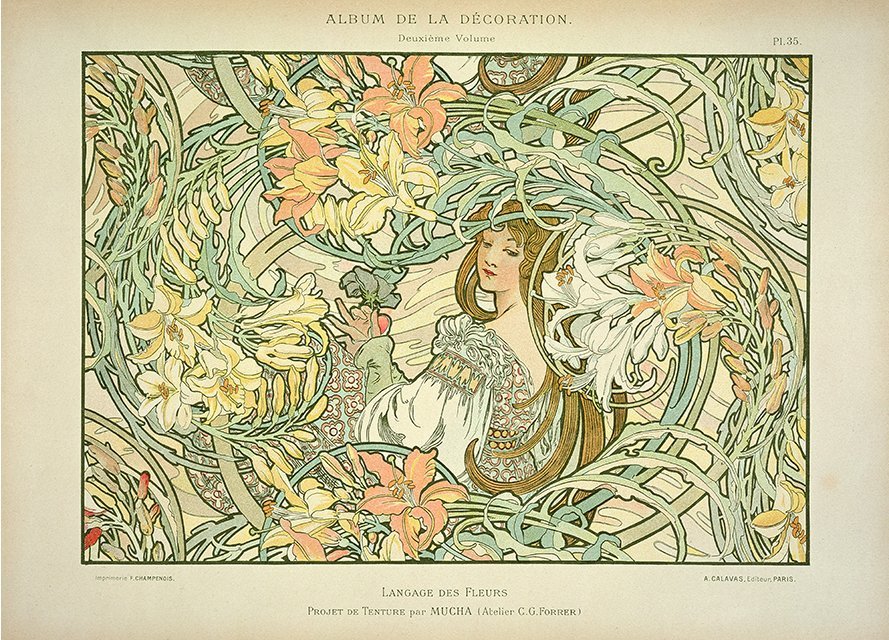
By Alphonse Mucha - ArtDaily.com via the Public Domain
The Victorians didn’t invent floriography—they copied it. The practice of sending coded messages through flowers originated with the Ottoman Turks, who used a complex system called “selam” to communicate sentiments that couldn’t be spoken aloud. When this practice reached Europe, particularly England, during the 18th and early 19th centuries, it was enthusiastically adapted and expanded.
What made the Victorian version particularly rich was how deeply it drew from mythology, folklore, and literature. Shakespeare’s plays, already centuries old by the Victorian era, had woven flowers throughout their narratives with symbolic intent. Ophelia’s famous flower speech in Hamlet—”There’s rosemary, that’s for remembrance. Pray you, love, remember. And there is pansies, that’s for thoughts”—became a cornerstone of Victorian floral symbolism.
The Victorians looked to classical mythology as well, connecting flowers to the stories of gods and goddesses. They understood that when Persephone picked narcissus, when Ophelia wore her floral crown, these weren’t random botanical choices—they were laden with meaning. Mythology and folklore provided the foundation, and Victorian floriography built an elaborate structure of communication upon it.
Each flower became a word, each bouquet a sentence. A narcissus could mean egotism or rebirth. A violet could express loyalty or herald spring. The context mattered, the combination mattered, even the way the flowers were presented mattered. This symbolic language allowed people to express emotions and ideas that society deemed too direct or improper to speak aloud.
Finding Ways to Honor the Seasons in Warmer Climates
Living in Florida, I’ve had to reckon with the fact that the seasonal wheel described in mythology and folklore simply doesn’t manifest the same way it does in northern climates. We don’t watch leaves turn and fall in autumn. We don’t see snow blanket the ground in winter. The birth-death-rebirth cycle that Persephone’s story so perfectly illustrates isn’t visible in our landscape the way it is for those who experience true seasonal shifts.
But this is where the mythology and the symbolism become even more vital. If I can’t mark the turning of the wheel through environmental changes, I can mark it through symbolic ones. Learning floriography—understanding that narcissus blooms in December and connects to Persephone’s descent, that violets emerge in February and signal her return—gives me a way to participate in these ancient cycles.
The flowers still bloom here, even if the climate is different. By learning their meanings, their mythological associations, their place in folklore and literature, I create my own seasonal markers. In December, I can still hang holly wreathes and lay narcissus (most likely silk) flowers on my altar. I can still acknowledge the descent into winter darkness, even if it’s 75 degrees outside. In February, I can decorate with violets and primrose (or perhaps I might try growing some?), and gift my sweet daughter a bouquet made with them as it’s her birth month. I can still celebrate spring’s promise, even if my garden has been green and budding all winter long.
The wheel of the year for warmer climates can’t just about what we witness in nature—we have to find ways to make it about the internal and symbolic cycles we all experience. Birth, growth, death, and rebirth happen in our lives regardless of climate. By embracing floriography and the rich tapestry of mythology and folklore it draws from, we can mark these transitions meaningfully. We can honor Persephone’s journey, Ophelia’s flowers, and all the layered meanings that flowers have carried through centuries of human storytelling.
In the end, perhaps those of us in warmer climates have an opportunity others might not—to engage with the seasons purely through symbol and story, to make the choice to mark the wheel intentionally rather than having it forced upon us by weather. We celebrate not because the earth demands it, but because we understand the deeper patterns at play—the ones that connect December narcissus to ancient abductions, February violets to promised returns, and all of us to the eternal cycle of descent and emergence that defines existence itself.
Bibliography:
Goodwin, Tim. “December Birth Flowers: Holly and Narcissus (Paperwhite) | The Old Farmer’s Almanac.” The Old Farmer’s Almanac, April 22, 2025. https://www.almanac.com/content/december-birth-flowers.
Goodwin, Tim. “February Birth Flowers: Primrose and Violet | What Do They Mean? | The Old Farmer’s Almanac.” The Old Farmer’s Almanac, April 22, 2025. https://www.almanac.com/content/february-birth-flowers.
Boeckmann, Catherine. “Flower Meanings: The Language of Flowers | Almanac.Com.” The Old Farmer’s Almanac, November 6, 2025. https://www.almanac.com/flower-meanings-language-flowers.
Henry, Rachel. The Language of Flowers 1550-1680: Four Floral Dictionaries Translated from the French with an Introduction & Notes. Sphinx House, 2023.
Henry, Rachel. The Language of Flowers 1810-1816: Delachenaye’s Abecedaire de Flore and Chambet’s Embleme Des Fleurs Translated into English. Sphinx House, 2023.
Henry, Rachel. The Language of Flowers: The Floral Dictionary of Anna Maria Campbell. Sphinx House, 2025.
Shakespeare, William. William Shakespeare: The Complete Works. Barnes and Noble Books, 1994.
